1912 · CLOSE READING
Book 4 (Part I)
Book 4 (Part I) (1912), PDF p. 29
Original page
Enlarge ↗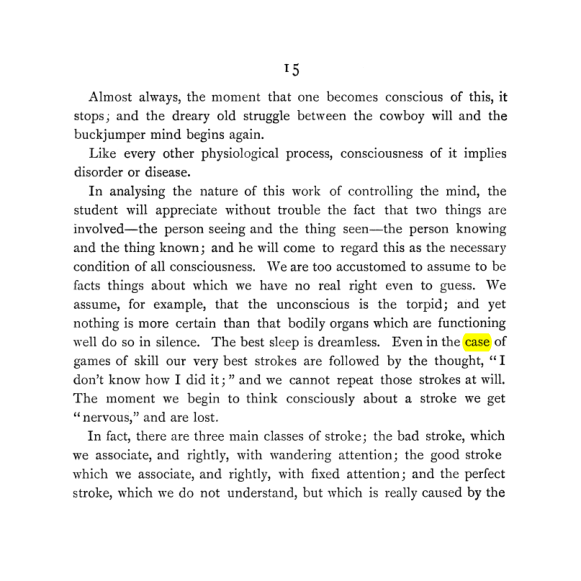
Highlights use the original PDF text layer. OCR-only matches may not be visible on the scan.
Transcription
Download text ↓raw extractionoriginal embedded textReview: unreviewed
I5
Almost always, the moment that one becomes conscious of this, it
stops, and the dreary old struggle between the cowboy will and the
buckjumper mind begins again.
Like every other physiological process, consciousness of it implies
disorder or disease.
In analysing the nature of this work of controlling the mind, the
student will appreciate without trouble the fact that two things are
involved—the person seeing and the thing seen—the person knowing
and the thing known; and he will come to regard this as the necessary
condition of all consciousness. We are too accustomed to assume to be
facts things about which we have no real right even to guess.
We
assume, for example,
that the unconscious is the torpid; and yet
nothing is more certain than that bodily organs which are functioning
well do so in silence.
The best sleep is dreamless. Even in the case of
games of skill our very best strokes are followed by the thought, “I
don’t know how I did it ; ” and we cannot repeat those strokes at will.
The moment we begin to think consciously about a stroke we get
“nervous,” and are lost.
In fact, there are three main classes of stroke; the bad stroke, which
we associate, and rightly, with wandering attention ; the good stroke
which we associate, and rightly, with fixed attention ,' and the perfect
stroke, which we do not understand, but which is really caused by the
Page provenance & review flags
Stable page ID: b57ece87819cbb5a1ea55583:p00029
Line breaks are preserved. Reading order and OCR accuracy may need review.
Printed page label has not been verified.
- No automated review flags. This does not establish transcription accuracy.