1912 · CLOSE READING
Book 4 (Part I)
Book 4 (Part I) (1912), PDF p. 49
Original page
Enlarge ↗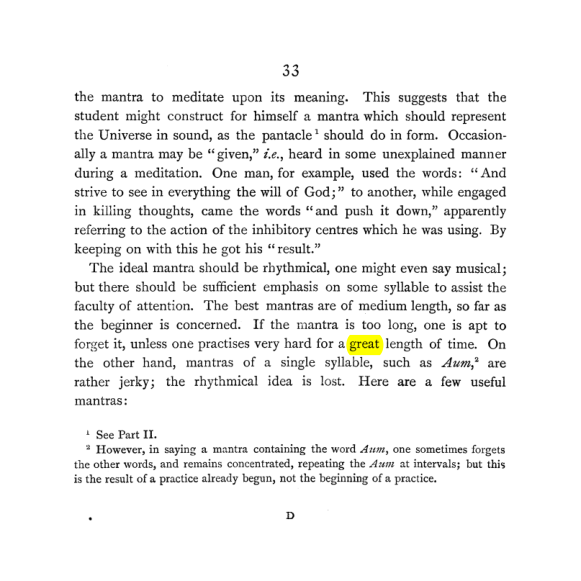
Highlights use the original PDF text layer. OCR-only matches may not be visible on the scan.
Transcription
Download text ↓raw extractionoriginal embedded textReview: unreviewed
33
the mantra to meditate upon its meaning.
This suggests that the
student might construct for himself a mantra which should represent
the Universe in sound, as the pantacle
1 should do in form. Occasion-
ally a mantra may be “given,” i.e., heard in some unexplained manner
during a meditation. One man, for example, used the words: “And
strive to see in everything the will of God; ” to another, while engaged
’ apparently
referring to the action of the inhibitory centres which he was using. By
in killing thoughts, came the words “and push it down,’
keeping on with this he got his “ result.”
The ideal mantra should be rhythmical, one might even say musical;
but there should be sufficient emphasis on some syllable to assist the
faculty of attention. The best mantras are of medium length, so far as
the beginner is concerned. If the mantra is too long, one is apt to
forget it, unless one practises very hard for a great length of time.
On
the other hand, mantras of a single
syllable,
such as Aumf are
rather jerky;
the rhythmical idea is lost.
Here are a few useful
mantras:
᾿See Part II.
2 However, in saying a mantra containing the word Azmz, one sometimes forgets
the other words, and remains concentrated, repeating the ΑΜ]; at intervals; but this
is the result of a practice already begun, not the beginning of a practice.
.
D
Page provenance & review flags
Stable page ID: b57ece87819cbb5a1ea55583:p00049
Line breaks are preserved. Reading order and OCR accuracy may need review.
Printed page label has not been verified.
- No automated review flags. This does not establish transcription accuracy.