1912 · CLOSE READING
Book 4 (Part I)
Book 4 (Part I) (1912), PDF p. 58
Original page
Enlarge ↗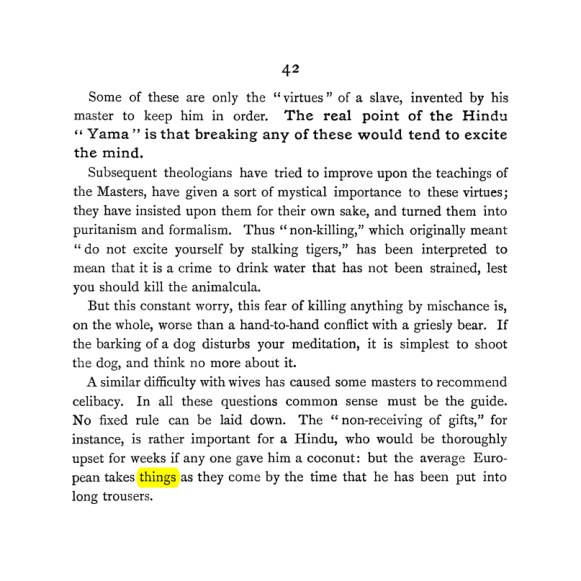
Highlights use the original PDF text layer. OCR-only matches may not be visible on the scan.
Transcription
Download text ↓raw extractionoriginal embedded textReview: unreviewed
42
Some of these are only the “virtues” of a slave, invented by his
master to keep him in order.
The real point of the Hindu
“ Yama ” is that breaking any of these would tend to excite
the mind.
Subsequent theologians have tried to improve upon the teachings of
the Masters, have given a sort of mystical importance to these virtues;
they have insisted upon them for their own sake, and turned them into
puritanism and formalism.
Thus “ non-killing,”which originally meant
“do not excite yourself by stalking tigers,” has been interpreted to
mean that it is a crime to drink water that has not been strained, lest
you should kill the animalcula.
But this constant worry, this fear of killing anything by mischance is,
on the whole, worse than a hand-to-hand conflict with a griesly bear. If
the barking of a dog disturbs your meditation, it is simplest to shoot
the dog, and think no more about it.
A similar difficulty with wives has caused some masters to recommend
celibacy.
In all these questions common sense must be the guide.
No fixed rule can be laid down.
The “non-receiving of gifts,” for
instance, is rather important for a Hindu, who would be thoroughly
upset for weeks if any one gave him a coconut: but the average Euro—
pean takes things as they come by the time that he has been put into
long trousers.
Page provenance & review flags
Stable page ID: b57ece87819cbb5a1ea55583:p00058
Line breaks are preserved. Reading order and OCR accuracy may need review.
Printed page label has not been verified.
- No automated review flags. This does not establish transcription accuracy.