1912 · CLOSE READING
Book 4 (Part I)
Book 4 (Part I) (1912), PDF p. 71
Original page
Enlarge ↗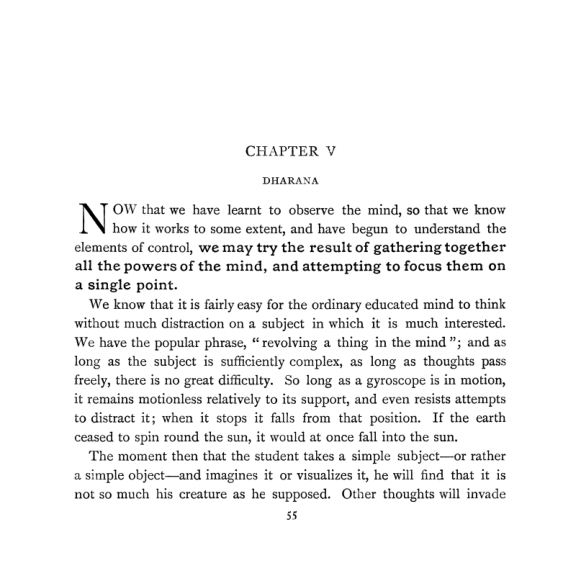
Highlights use the original PDF text layer. OCR-only matches may not be visible on the scan.
Transcription
Download text ↓raw extractionoriginal embedded textReview: unreviewed
CHAPTER V
DHARANA
OW that we have learnt to observe the mind, so that we know
how it works to some extent, and have begun to understand the
elements of control, we may try the resultof gathering together
all the powers of the mind, and attempting to focus them on
a single point.
We know that it is fairly easy for the ordinary educated mind to think
without much distraction on a subject in which it is much interested.
We have the popular phrase, “ revolving a thing in the mind ”; and as
long as the subject is sufficiently complex,
as long as thoughts pass
freely, there is no great difficulty.
So long as a gyroscope is in motion,
it remains motionless relatively to its support, and even resists attempts
to distract it; when it stops it falls from that position. If the earth
ceased to spin round the sun, it would at once fall into the sun.
The moment then that the student takes a simple subject—or rather
a simple object—and imagines it or visualizes it, he will find that it is
not so much his creature as he supposed. Other thoughts will invade
55
Page provenance & review flags
Stable page ID: b57ece87819cbb5a1ea55583:p00071
Line breaks are preserved. Reading order and OCR accuracy may need review.
Printed page label has not been verified.
- No automated review flags. This does not establish transcription accuracy.