1912 · CLOSE READING
Book 4 (Part I)
Book 4 (Part I) (1912), PDF p. 73
Original page
Enlarge ↗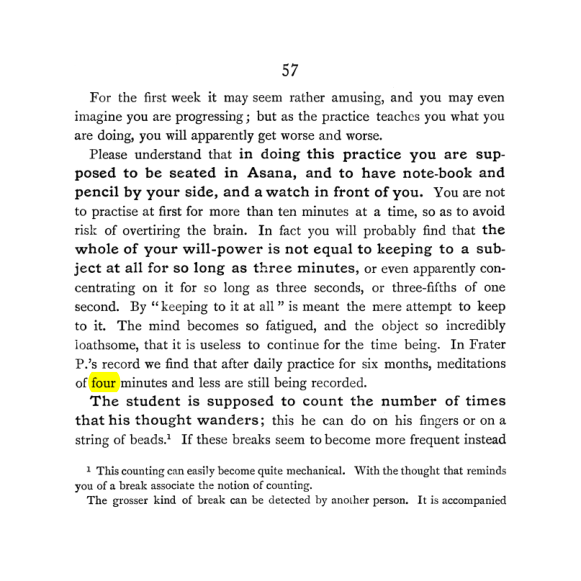
Highlights use the original PDF text layer. OCR-only matches may not be visible on the scan.
Transcription
Download text ↓raw extractionoriginal embedded textReview: unreviewed
57
For the first week it may seem rather amusing, and you may even
imagine you are progressing; but as the practice teaches you what you
are doing, you will apparently get worse and worse.
Please understand that in doing this practice you are sup-
posed to be seated in Asana, and to have note-book and
pencil by your side, and a watch in front of you. You are not
to practise at first for more than ten minutes at a time, so as to avoid
risk of overtiring the brain. In fact you will probably find that the
Whole of your will-power is not equal to keeping to a sub-
ject at all for so long as three minutes, or even apparently con—
centrating on it for so long as three seconds, or three-fifths of one
second. By “keeping to it at all” is meant the mere attempt to keep
to it.
The mind becomes so fatigued, and the object so incredibly
loathsome, that it is useless to continue for the time being. In Frater
R’s record we find that after daily practice for six months, meditations
of four minutes and less are still being recorded.
The student is supposed to count the number of times
that his thought wanders; this he can do on his fingers or on a
string of beads.1 If these breaks seem to become more frequent instead
1 This counting can easily become quite mechanical.
With the thought that reminds
you of a break associate the notion of counting.
The grosser kind of break can be detected by another person. It is accompanied
Page provenance & review flags
Stable page ID: b57ece87819cbb5a1ea55583:p00073
Line breaks are preserved. Reading order and OCR accuracy may need review.
Printed page label has not been verified.
- No automated review flags. This does not establish transcription accuracy.