1912 · CLOSE READING
Book 4 (Part I)
Book 4 (Part I) (1912), PDF p. 79
Original page
Enlarge ↗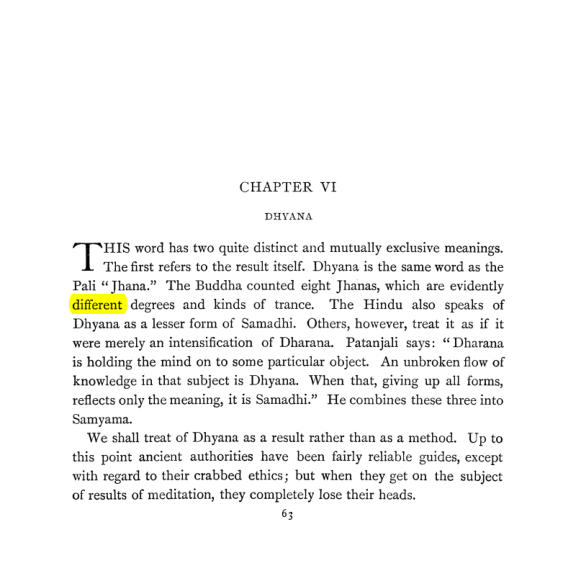
Highlights use the original PDF text layer. OCR-only matches may not be visible on the scan.
Transcription
Download text ↓raw extractionoriginal embedded textReview: unreviewed
CHAPTER VI
DHYANA
HIS word has two quite distinct and mutually exclusive meanings.
The first refers to the result itself. Dhyana is the same word as the
Pali “Jhana.” The Buddha counted eight Jha'nas, which are evidently
different degrees and kinds of trance.
The Hindu
also
speaks of
Dhyana as a lesser form of Samadhi. Others, however, treat it as if it
were merely an intensification of Dharana. Patanjali says: “Dharana
is holding the mind on to some particular object. An unbroken flow of
knowledge in that subject is Dhyana. When that, giving up all forms,
reflects only the meaning, it is Samadhi.” He combines these three into
Samyama.
We shall treat of Dhyana as a result rather than as a method. Up to
this point ancient authorities have been fairly reliable guides, except
with regard to their crabbed ethics,- but when they get on the subject
of results of meditation, they completely lose their heads.
63
Page provenance & review flags
Stable page ID: b57ece87819cbb5a1ea55583:p00079
Line breaks are preserved. Reading order and OCR accuracy may need review.
Printed page label has not been verified.
- No automated review flags. This does not establish transcription accuracy.