1912 · CLOSE READING
Book 4 (Part I)
Book 4 (Part I) (1912), PDF p. 90
Original page
Enlarge ↗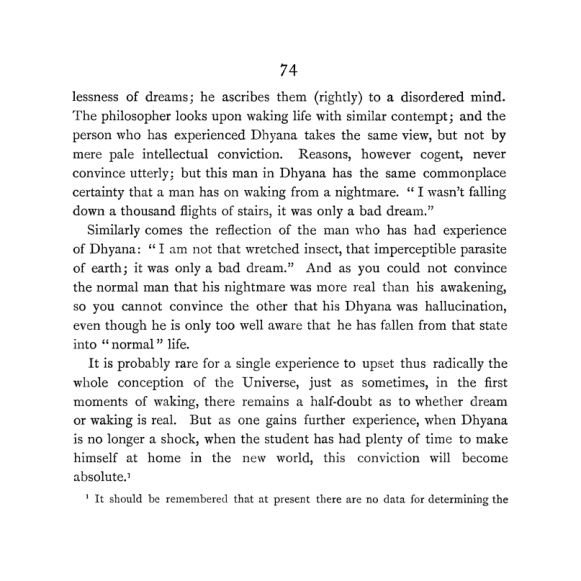
Highlights use the original PDF text layer. OCR-only matches may not be visible on the scan.
Transcription
Download text ↓raw extractionoriginal embedded textReview: unreviewed
74
lessness of dreams,' he ascribes them (rightly) to a disordered mind.
The philosopher looks upon waking life with similar contempt ; and the
person who has experienced Dhyana takes the same View, but not by
mere pale intellectual conviction.
Reasons, hoWever cogent, never
convince utterly; but this man in Dhyana has the same commonplace
certainty that a man has on waking from a nightmare. “ I wasn’t falling
down a thousand flights of stairs, it was only a bad dream.”
Similarly comes the reflection of the man who has had experience
of Dhyana: “ I am not that wretched insect, that imperceptible parasite
of earth ; it was only a bad dream.” And as you could not convince
the normal man that his nightmare was more real than his awakening,
so you cannot convince the other that his Dhyana was hallucination,
even though he is only too well aware that he has fallen from that state
into “normal” life.
It is probably rare for a single experience to upset thus radically the
whole conception of the Universe, just as sometimes, in the first
moments of waking, there remains a half-doubt as to whether dream
or waking is real.
But as one gains further experience, when Dhyana
is no longer a shock, when the student has had plenty of time to make
himself at home in the
new
world,
this
conviction will become
absolute.1
᾽It should be remembered that at present there are no data for determining the
Page provenance & review flags
Stable page ID: b57ece87819cbb5a1ea55583:p00090
Line breaks are preserved. Reading order and OCR accuracy may need review.
Printed page label has not been verified.
- No automated review flags. This does not establish transcription accuracy.