1929 · CLOSE READING
Moonchild
Moonchild (1929), PDF p. 114
Original page
Enlarge ↗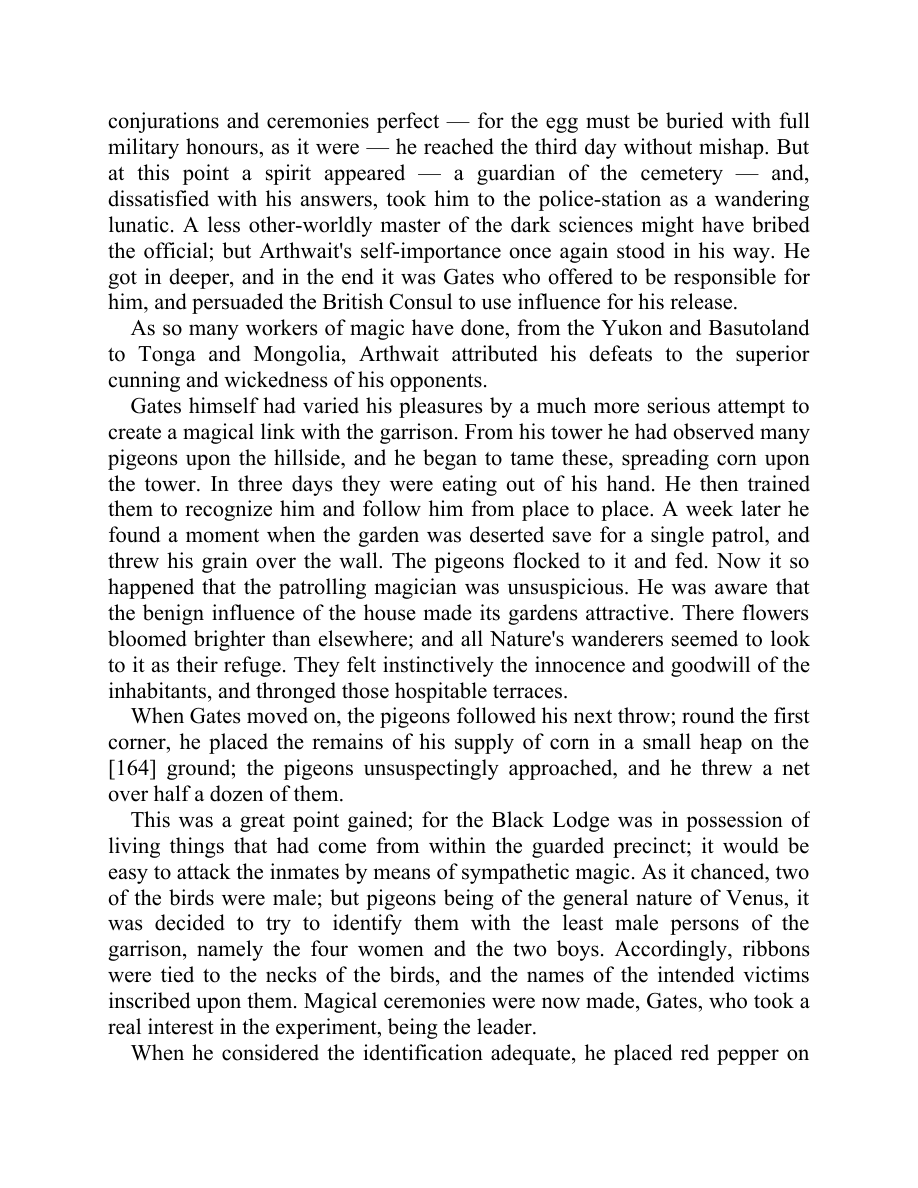
Highlights use the original PDF text layer. OCR-only matches may not be visible on the scan.
Transcription
Download text ↓raw extractionoriginal embedded textReview: unreviewed
conjurations and ceremonies perfect — for the egg must be buried with full
military honours, as it were — he reached the third day without mishap. But
at this point a spirit appeared — a guardian of the cemetery — and,
dissatisfied with his answers, took him to the police-station as a wandering
lunatic. A less other-worldly master of the dark sciences might have bribed
the official; but Arthwait's self-importance once again stood in his way. He
got in deeper, and in the end it was Gates who offered to be responsible for
him, and persuaded the British Consul to use influence for his release.
As so many workers of magic have done, from the Yukon and Basutoland
to Tonga and Mongolia, Arthwait attributed his defeats to the superior
cunning and wickedness of his opponents.
Gates himself had varied his pleasures by a much more serious attempt to
create a magical link with the garrison. From his tower he had observed many
pigeons upon the hillside, and he began to tame these, spreading corn upon
the tower. In three days they were eating out of his hand. He then trained
them to recognize him and follow him from place to place. A week later he
found a moment when the garden was deserted save for a single patrol, and
threw his grain over the wall. The pigeons flocked to it and fed. Now it so
happened that the patrolling magician was unsuspicious. He was aware that
the benign influence of the house made its gardens attractive. There flowers
bloomed brighter than elsewhere; and all Nature's wanderers seemed to look
to it as their refuge. They felt instinctively the innocence and goodwill of the
inhabitants, and thronged those hospitable terraces.
When Gates moved on, the pigeons followed his next throw; round the first
corner, he placed the remains of his supply of corn in a small heap on the
[164] ground; the pigeons unsuspectingly approached, and he threw a net
over half a dozen of them.
This was a great point gained; for the Black Lodge was in possession of
living things that had come from within the guarded precinct; it would be
easy to attack the inmates by means of sympathetic magic. As it chanced, two
of the birds were male; but pigeons being of the general nature of Venus, it
was decided to try to identify them with the least male persons of the
garrison, namely the four women and the two boys. Accordingly, ribbons
were tied to the necks of the birds, and the names of the intended victims
inscribed upon them. Magical ceremonies were now made, Gates, who took a
real interest in the experiment, being the leader.
When he considered the identification adequate, he placed red pepper on
Page provenance & review flags
Stable page ID: ba1adb09e3af8d702fe24282:p00114
Line breaks are preserved. Reading order and OCR accuracy may need review.
Printed page label has not been verified.
- No automated review flags. This does not establish transcription accuracy.