1929 · CLOSE READING
Moonchild
Moonchild (1929), PDF p. 126
Original page
Enlarge ↗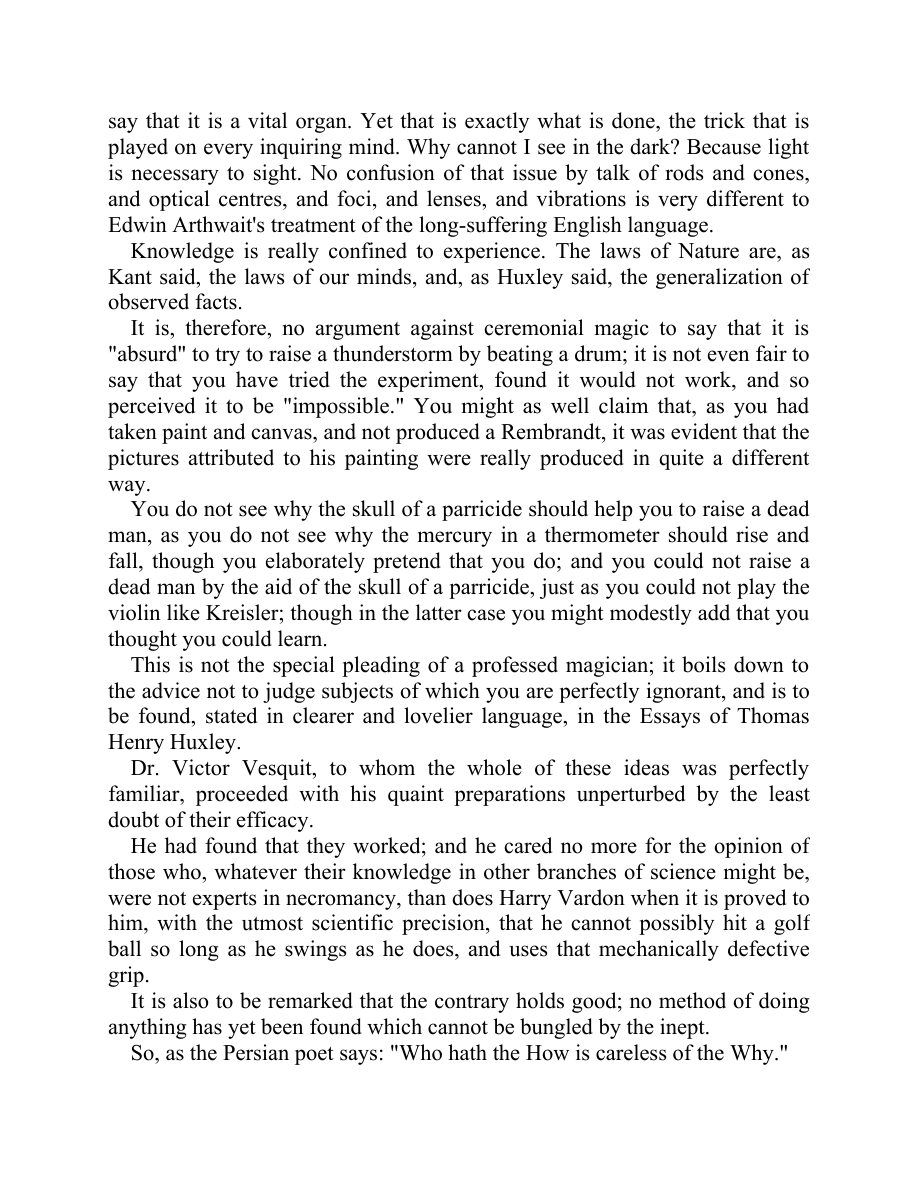
Highlights use the original PDF text layer. OCR-only matches may not be visible on the scan.
Transcription
Download text ↓raw extractionoriginal embedded textReview: unreviewed
say that it is a vital organ. Yet that is exactly what is done, the trick that is
played on every inquiring mind. Why cannot I see in the dark? Because light
is necessary to sight. No confusion of that issue by talk of rods and cones,
and optical centres, and foci, and lenses, and vibrations is very different to
Edwin Arthwait's treatment of the long-suffering English language.
Knowledge is really confined to experience. The laws of Nature are, as
Kant said, the laws of our minds, and, as Huxley said, the generalization of
observed facts.
It is, therefore, no argument against ceremonial magic to say that it is
"absurd" to try to raise a thunderstorm by beating a drum; it is not even fair to
say that you have tried the experiment, found it would not work, and so
perceived it to be "impossible." You might as well claim that, as you had
taken paint and canvas, and not produced a Rembrandt, it was evident that the
pictures attributed to his painting were really produced in quite a different
way.
You do not see why the skull of a parricide should help you to raise a dead
man, as you do not see why the mercury in a thermometer should rise and
fall, though you elaborately pretend that you do; and you could not raise a
dead man by the aid of the skull of a parricide, just as you could not play the
violin like Kreisler; though in the latter case you might modestly add that you
thought you could learn.
This is not the special pleading of a professed magician; it boils down to
the advice not to judge subjects of which you are perfectly ignorant, and is to
be found, stated in clearer and lovelier language, in the Essays of Thomas
Henry Huxley.
Dr. Victor Vesquit, to whom the whole of these ideas was perfectly
familiar, proceeded with his quaint preparations unperturbed by the least
doubt of their efficacy.
He had found that they worked; and he cared no more for the opinion of
those who, whatever their knowledge in other branches of science might be,
were not experts in necromancy, than does Harry Vardon when it is proved to
him, with the utmost scientific precision, that he cannot possibly hit a golf
ball so long as he swings as he does, and uses that mechanically defective
grip.
It is also to be remarked that the contrary holds good; no method of doing
anything has yet been found which cannot be bungled by the inept.
So, as the Persian poet says: "Who hath the How is careless of the Why."
Page provenance & review flags
Stable page ID: ba1adb09e3af8d702fe24282:p00126
Line breaks are preserved. Reading order and OCR accuracy may need review.
Printed page label has not been verified.
- No automated review flags. This does not establish transcription accuracy.