1929 · CLOSE READING
Moonchild
Moonchild (1929), PDF p. 187
Original page
Enlarge ↗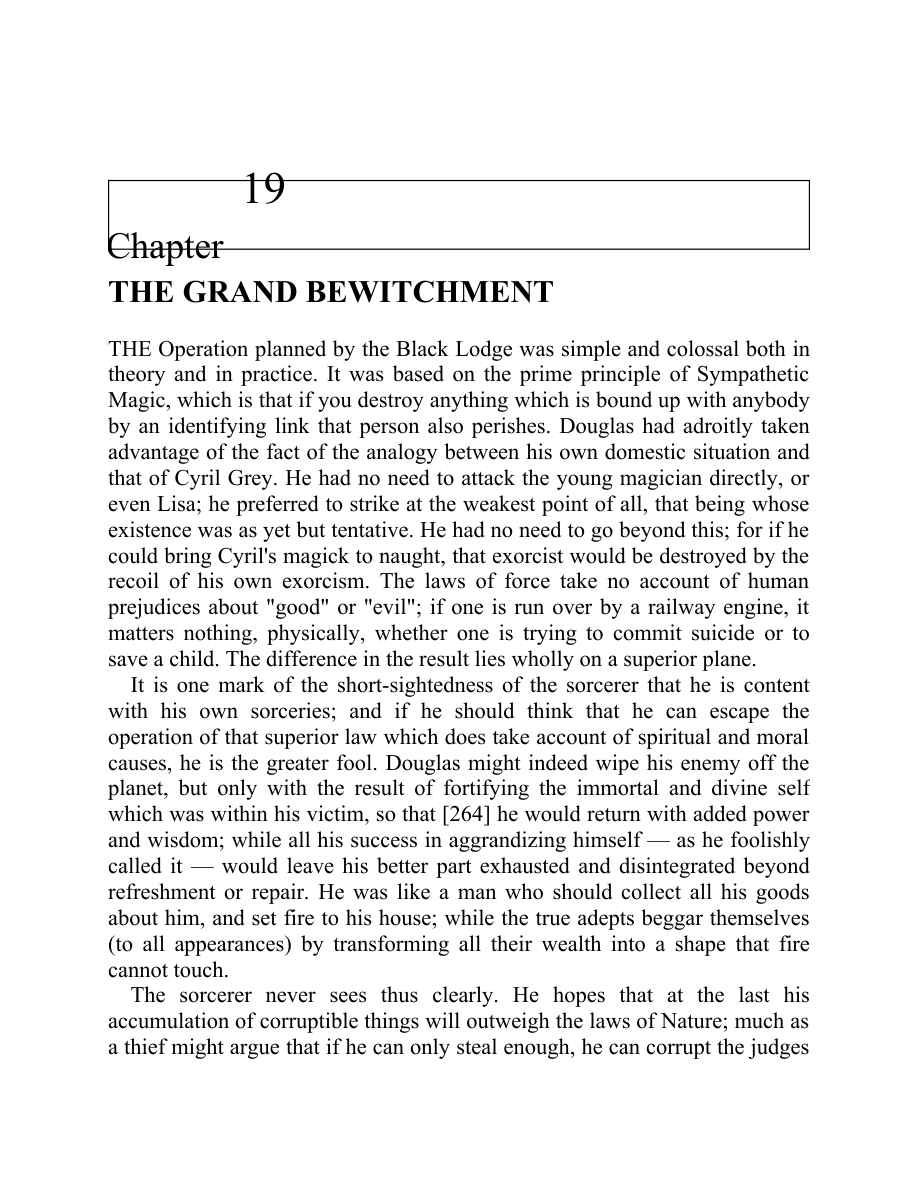
Highlights use the original PDF text layer. OCR-only matches may not be visible on the scan.
Transcription
Download text ↓raw extractionoriginal embedded textReview: unreviewed
19
Chapter
THE GRAND BEWITCHMENT
THE Operation planned by the Black Lodge was simple and colossal both in
theory and in practice. It was based on the prime principle of Sympathetic
Magic, which is that if you destroy anything which is bound up with anybody
by an identifying link that person also perishes. Douglas had adroitly taken
advantage of the fact of the analogy between his own domestic situation and
that of Cyril Grey. He had no need to attack the young magician directly, or
even Lisa; he preferred to strike at the weakest point of all, that being whose
existence was as yet but tentative. He had no need to go beyond this; for if he
could bring Cyril's magick to naught, that exorcist would be destroyed by the
recoil of his own exorcism. The laws of force take no account of human
prejudices about "good" or "evil"; if one is run over by a railway engine, it
matters nothing, physically, whether one is trying to commit suicide or to
save a child. The difference in the result lies wholly on a superior plane.
It is one mark of the short-sightedness of the sorcerer that he is content
with his own sorceries; and if he should think that he can escape the
operation of that superior law which does take account of spiritual and moral
causes, he is the greater fool. Douglas might indeed wipe his enemy off the
planet, but only with the result of fortifying the immortal and divine self
which was within his victim, so that [264] he would return with added power
and wisdom; while all his success in aggrandizing himself — as he foolishly
called it — would leave his better part exhausted and disintegrated beyond
refreshment or repair. He was like a man who should collect all his goods
about him, and set fire to his house; while the true adepts beggar themselves
(to all appearances) by transforming all their wealth into a shape that fire
cannot touch.
The sorcerer never sees thus clearly. He hopes that at the last his
accumulation of corruptible things will outweigh the laws of Nature; much as
a thief might argue that if he can only steal enough, he can corrupt the judges
Page provenance & review flags
Stable page ID: ba1adb09e3af8d702fe24282:p00187
Line breaks are preserved. Reading order and OCR accuracy may need review.
Printed page label has not been verified.
- No automated review flags. This does not establish transcription accuracy.