1909 · CLOSE READING
The Equinox (Volume I, Number II)
The Equinox (Volume I, Number II) (1909), PDF p. 327
Original page
Enlarge ↗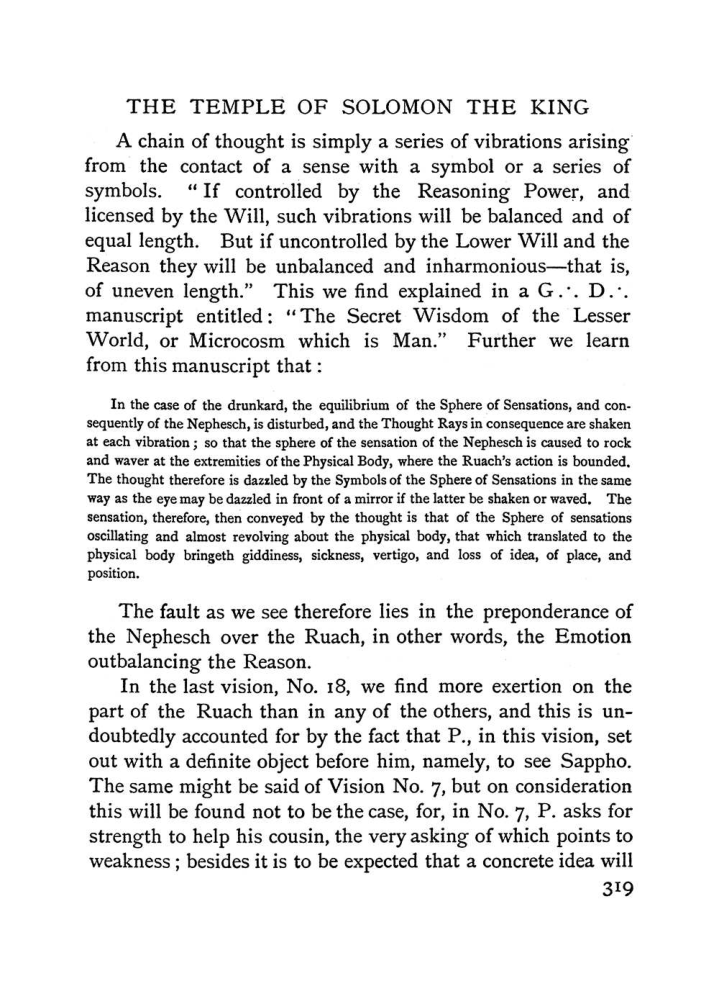
Highlights use the original PDF text layer. OCR-only matches may not be visible on the scan.
Transcription
Download text ↓raw extractionoriginal embedded textReview: unreviewed
THE TEMPLE OF SOLOMON THE KING
A chain of thought is simply a series of vibrations arising
from the contact of a sense with a symbol or a series of
symbols. “If controlled by the Reasoning Power, and
licensed by the Will, such vibrations will be balanced and of
equal length. But if uncontrolled by the Lower Will and the
Reason they will be unbalanced and inharmonious—that is,
of uneven length.” This we find explained in a G.*. D.-.
manuscript entitled: ‘The Secret Wisdom of the Lesser
World, or Microcosm which is Man.” Further we learn
from this manuscript that :
In the case of the drunkard, the equilibrium of the Sphere of Sensations, and con-
sequently of the Nephesch, is disturbed, and the Thought Rays in consequence are shaken
at each vibration; so that the sphere of the sensation of the Nephesch is caused to rock
and waver at the extremities of the Physical Body, where the Ruach’s action is bounded,
The thought therefore is dazzled by the Symbols of the Sphere of Sensations in the same
way as the eye may be dazzled in front of a mirror if the latter be shaken or waved. The
sensation, therefore, then conveyed by the thought is that of the Sphere of sensations
oscillating and almost revolving about the physical body, that which translated to the
physical body bringeth giddiness, sickness, vertigo, and loss of idea, of place, and
position.
The fault as we see therefore lies in the preponderance of
the Nephesch over the Ruach, in other words, the Emotion
outbalancing the Reason.
In the last vision, No. 18, we find more exertion on the
part of the Ruach than in any of the others, and this is un-
doubtedly accounted for by the fact that P., in this vision, set
out with a definite object before him, namely, to see Sappho.
The same might be said of Vision No. 7, but on consideration
this will be found not to be the case, for, in No. 7, P. asks for
strength to help his cousin, the very asking of which points to
weakness ; besides it is to be expected that a concrete idea will
319
Page provenance & review flags
Stable page ID: bf2afab45b1dc0687d2d189d:p00327
Line breaks are preserved. Reading order and OCR accuracy may need review.
Printed page label has not been verified.
- No automated review flags. This does not establish transcription accuracy.