1944 · CLOSE READING
The Book of Thoth
The Book of Thoth (1944), PDF p. 119
Original page
Enlarge ↗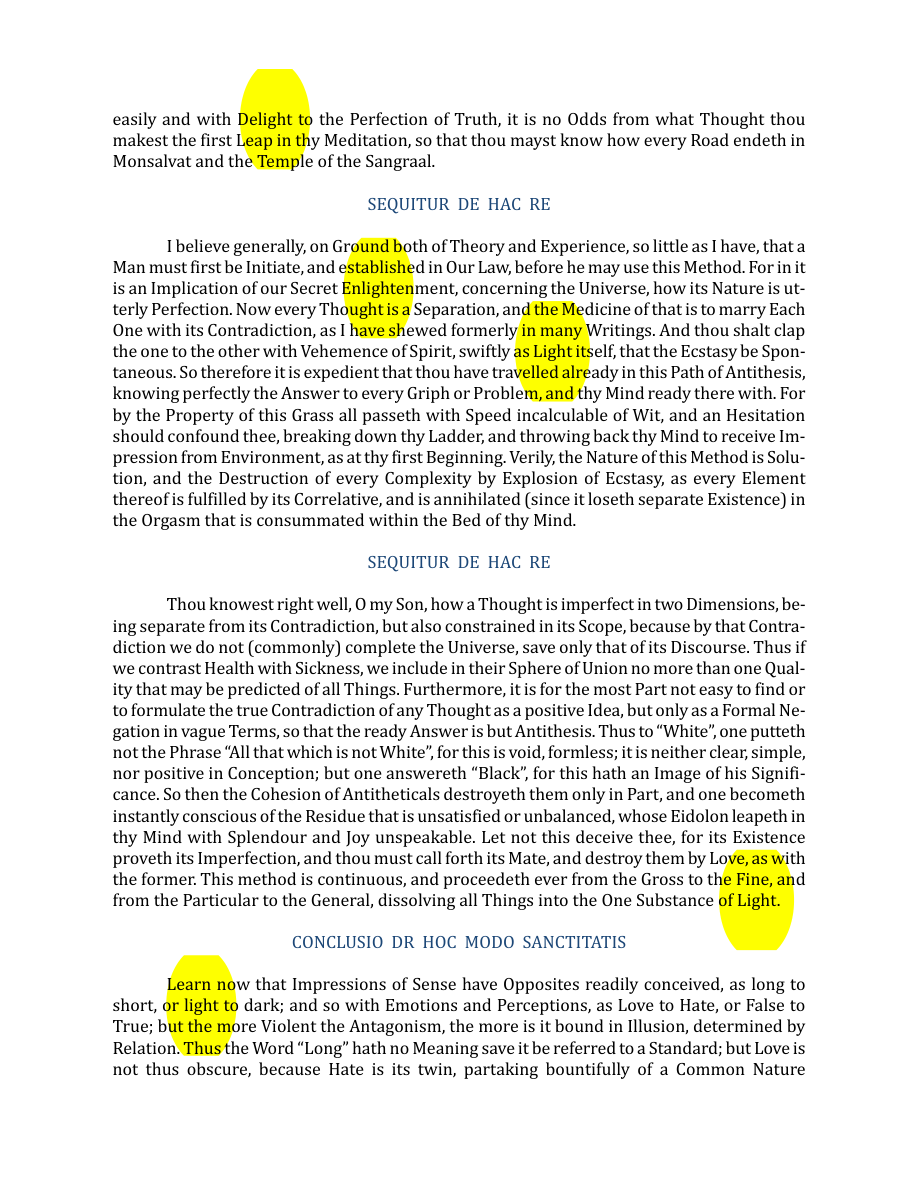
Highlights use the original PDF text layer. OCR-only matches may not be visible on the scan.
Transcription
Download text ↓raw extractionoriginal embedded textReview: unreviewed
easily and with Delight to the Perfection of Truth, it is no Odds from what Thought thou
makest the first Leap in thy Meditation, so that thou mayst know how every Road endeth in
Monsalvat and the Temple of the Sangraal.
SEQUITUR DE HAC RE
I believe generally, on Ground both of Theory and Experience, so little as I have, that a
Man must first be Initiate, and established in Our Law, before he may use this Method. For in it
is an Implication of our Secret Enlightenment, concerning the Universe, how its Nature is ut‐
terly Perfection. Now every Thought is a Separation, and the Medicine of that is to marry Each
One with its Contradiction, as I have shewed formerly in many Writings. And thou shalt clap
the one to the other with Vehemence of Spirit, swiftly as Light itself, that the Ecstasy be Spon‐
taneous. So therefore it is expedient that thou have travelled already in this Path of Antithesis,
knowing perfectly the Answer to every Griph or Problem, and thy Mind ready there with. For
by the Property of this Grass all passeth with Speed incalculable of Wit, and an Hesitation
should confound thee, breaking down thy Ladder, and throwing back thy Mind to receive Im‐
pression from Environment, as at thy first Beginning. Verily, the Nature of this Method is Solu‐
tion, and the Destruction of every Complexity by Explosion of Ecstasy, as every Element
thereof is fulfilled by its Correlative, and is annihilated (since it loseth separate Existence) in
the Orgasm that is consummated within the Bed of thy Mind.
SEQUITUR DE HAC RE
Thou knowest right well, O my Son, how a Thought is imperfect in two Dimensions, be‐
ing separate from its Contradiction, but also constrained in its Scope, because by that Contra‐
diction we do not (commonly) complete the Universe, save only that of its Discourse. Thus if
we contrast Health with Sickness, we include in their Sphere of Union no more than one Qual‐
ity that may be predicted of all Things. Furthermore, it is for the most Part not easy to find or
to formulate the true Contradiction of any Thought as a positive Idea, but only as a Formal Ne‐
gation in vague Terms, so that the ready Answer is but Antithesis. Thus to “White”, one putteth
not the Phrase “All that which is not White”, for this is void, formless; it is neither clear, simple,
nor positive in Conception; but one answereth “Black”, for this hath an Image of his Signifi‐
cance. So then the Cohesion of Antitheticals destroyeth them only in Part, and one becometh
instantly conscious of the Residue that is unsatisfied or unbalanced, whose Eidolon leapeth in
thy Mind with Splendour and Joy unspeakable. Let not this deceive thee, for its Existence
proveth its Imperfection, and thou must call forth its Mate, and destroy them by Love, as with
the former. This method is continuous, and proceedeth ever from the Gross to the Fine, and
from the Particular to the General, dissolving all Things into the One Substance of Light.
CONCLUSIO DR HOC MODO SANCTITATIS
Learn now that Impressions of Sense have Opposites readily conceived, as long to
short, or light to dark; and so with Emotions and Perceptions, as Love to Hate, or False to
True; but the more Violent the Antagonism, the more is it bound in Illusion, determined by
Relation. Thus the Word “Long” hath no Meaning save it be referred to a Standard; but Love is
not thus obscure, because Hate is its twin, partaking bountifully of a Common Nature
Page provenance & review flags
Stable page ID: c2293fa5b8d18e0cf1f666dc:p00119
Line breaks are preserved. Reading order and OCR accuracy may need review.
Printed page label has not been verified.
- legacy text differs review