1944 · CLOSE READING
The Book of Thoth
The Book of Thoth (1944), PDF p. 147
Original page
Enlarge ↗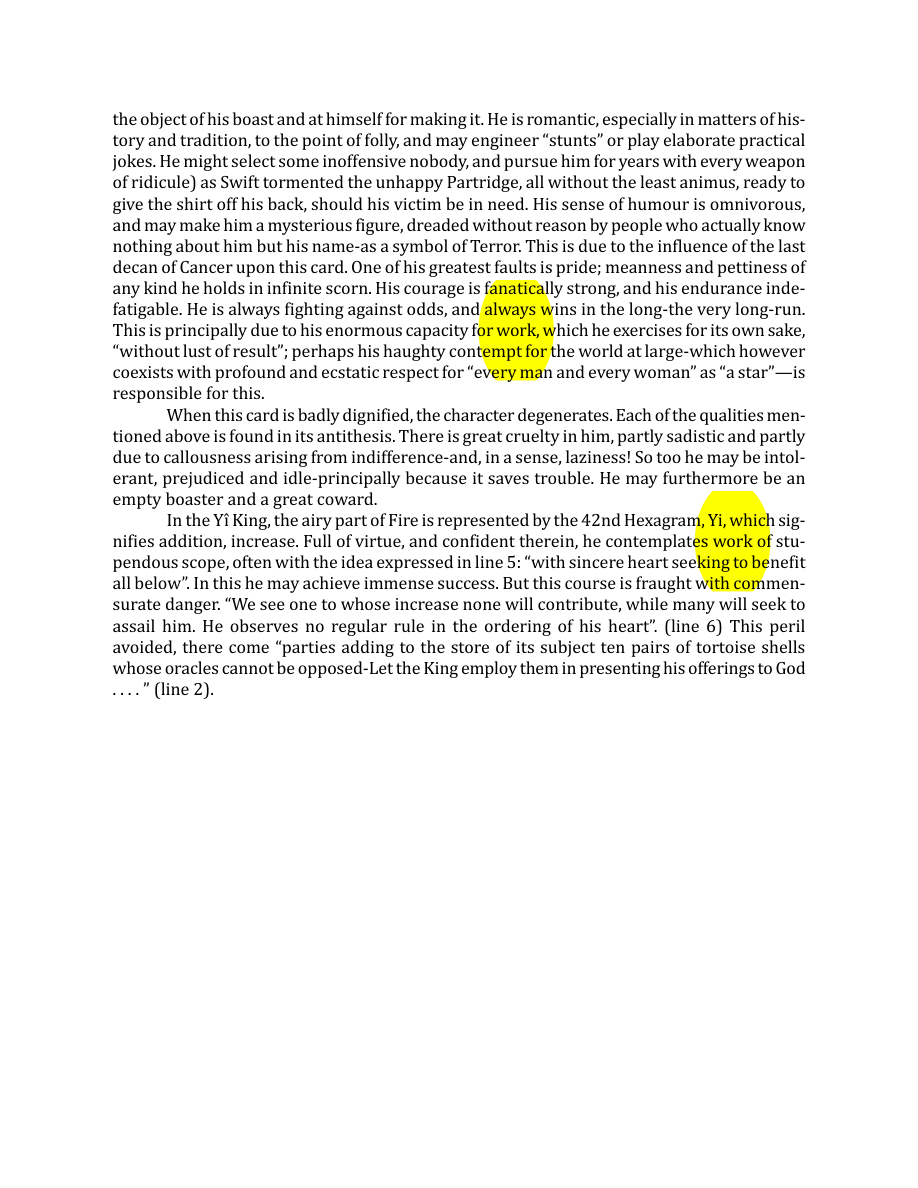
Highlights use the original PDF text layer. OCR-only matches may not be visible on the scan.
Transcription
Download text ↓raw extractionoriginal embedded textReview: unreviewed
the object of his boast and at himself for making it. He is romantic, especially in matters of his‐
tory and tradition, to the point of folly, and may engineer “stunts” or play elaborate practical
jokes. He might select some inoffensive nobody, and pursue him for years with every weapon
of ridicule) as Swift tormented the unhappy Partridge, all without the least animus, ready to
give the shirt off his back, should his victim be in need. His sense of humour is omnivorous,
and may make him a mysterious figure, dreaded without reason by people who actually know
nothing about him but his name‐as a symbol of Terror. This is due to the influence of the last
decan of Cancer upon this card. One of his greatest faults is pride; meanness and pettiness of
any kind he holds in infinite scorn. His courage is fanatically strong, and his endurance inde‐
fatigable. He is always fighting against odds, and always wins in the long‐the very long‐run.
This is principally due to his enormous capacity for work, which he exercises for its own sake,
“without lust of result”; perhaps his haughty contempt for the world at large‐which however
coexists with profound and ecstatic respect for “every man and every woman” as “a star”—is
responsible for this.
When this card is badly dignified, the character degenerates. Each of the qualities men‐
tioned above is found in its antithesis. There is great cruelty in him, partly sadistic and partly
due to callousness arising from indifference‐and, in a sense, laziness! So too he may be intol‐
erant, prejudiced and idle‐principally because it saves trouble. He may furthermore be an
empty boaster and a great coward.
In the Yî King, the airy part of Fire is represented by the 42nd Hexagram, Yi, which sig‐
nifies addition, increase. Full of virtue, and confident therein, he contemplates work of stu‐
pendous scope, often with the idea expressed in line 5: “with sincere heart seeking to benefit
all below”. In this he may achieve immense success. But this course is fraught with commen‐
surate danger. “We see one to whose increase none will contribute, while many will seek to
assail him. He observes no regular rule in the ordering of his heart”. (line 6) This peril
avoided, there come “parties adding to the store of its subject ten pairs of tortoise shells
whose oracles cannot be opposed‐Let the King employ them in presenting his offerings to God
. . . . ” (line 2).
Page provenance & review flags
Stable page ID: c2293fa5b8d18e0cf1f666dc:p00147
Line breaks are preserved. Reading order and OCR accuracy may need review.
Printed page label has not been verified.
- No automated review flags. This does not establish transcription accuracy.