1944 · CLOSE READING
The Book of Thoth
The Book of Thoth (1944), PDF p. 23
Original page
Enlarge ↗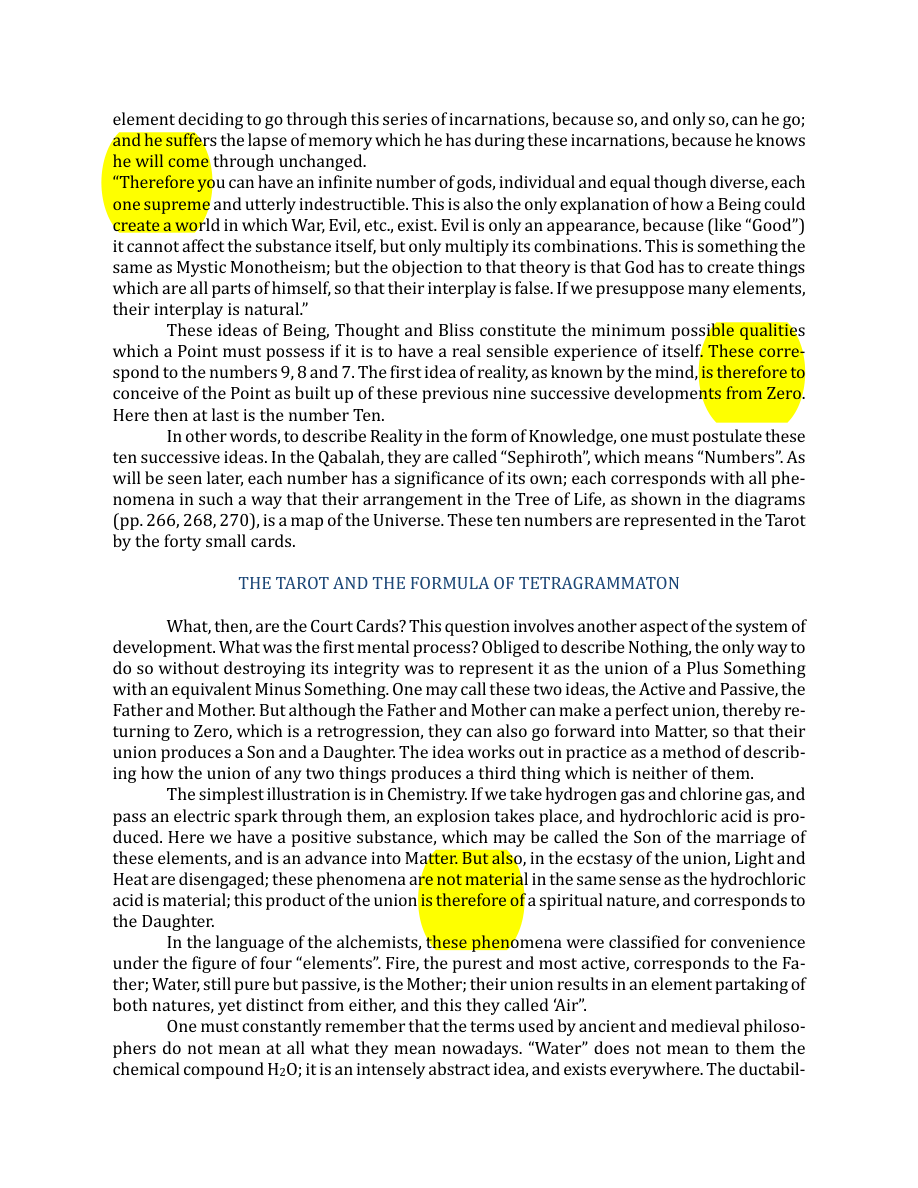
Highlights use the original PDF text layer. OCR-only matches may not be visible on the scan.
Transcription
Download text ↓raw extractionoriginal embedded textReview: unreviewed
element deciding to go through this series of incarnations, because so, and only so, can he go;
and he suffers the lapse of memory which he has during these incarnations, because he knows
he will come through unchanged.
“Therefore you can have an infinite number of gods, individual and equal though diverse, each
one supreme and utterly indestructible. This is also the only explanation of how a Being could
create a world in which War, Evil, etc., exist. Evil is only an appearance, because (like “Good”)
it cannot affect the substance itself, but only multiply its combinations. This is something the
same as Mystic Monotheism; but the objection to that theory is that God has to create things
which are all parts of himself, so that their interplay is false. If we presuppose many elements,
their interplay is natural.”
These ideas of Being, Thought and Bliss constitute the minimum possible qualities
which a Point must possess if it is to have a real sensible experience of itself. These corre‐
spond to the numbers 9, 8 and 7. The first idea of reality, as known by the mind, is therefore to
conceive of the Point as built up of these previous nine successive developments from Zero.
Here then at last is the number Ten.
In other words, to describe Reality in the form of Knowledge, one must postulate these
ten successive ideas. In the Qabalah, they are called “Sephiroth”, which means “Numbers”. As
will be seen later, each number has a significance of its own; each corresponds with all phe‐
nomena in such a way that their arrangement in the Tree of Life, as shown in the diagrams
(pp. 266, 268, 270), is a map of the Universe. These ten numbers are represented in the Tarot
by the forty small cards.
THE TAROT AND THE FORMULA OF TETRAGRAMMATON
What, then, are the Court Cards? This question involves another aspect of the system of
development. What was the first mental process? Obliged to describe Nothing, the only way to
do so without destroying its integrity was to represent it as the union of a Plus Something
with an equivalent Minus Something. One may call these two ideas, the Active and Passive, the
Father and Mother. But although the Father and Mother can make a perfect union, thereby re‐
turning to Zero, which is a retrogression, they can also go forward into Matter, so that their
union produces a Son and a Daughter. The idea works out in practice as a method of describ‐
ing how the union of any two things produces a third thing which is neither of them.
The simplest illustration is in Chemistry. If we take hydrogen gas and chlorine gas, and
pass an electric spark through them, an explosion takes place, and hydrochloric acid is pro‐
duced. Here we have a positive substance, which may be called the Son of the marriage of
these elements, and is an advance into Matter. But also, in the ecstasy of the union, Light and
Heat are disengaged; these phenomena are not material in the same sense as the hydrochloric
acid is material; this product of the union is therefore of a spiritual nature, and corresponds to
the Daughter.
In the language of the alchemists, these phenomena were classified for convenience
under the figure of four “elements”. Fire, the purest and most active, corresponds to the Fa‐
ther; Water, still pure but passive, is the Mother; their union results in an element partaking of
both natures, yet distinct from either, and this they called ‘Air”.
One must constantly remember that the terms used by ancient and medieval philoso‐
phers do not mean at all what they mean nowadays. “Water” does not mean to them the
chemical compound H2O; it is an intensely abstract idea, and exists everywhere. The ductabil‐
Page provenance & review flags
Stable page ID: c2293fa5b8d18e0cf1f666dc:p00023
Line breaks are preserved. Reading order and OCR accuracy may need review.
Printed page label has not been verified.
- No automated review flags. This does not establish transcription accuracy.