1944 · CLOSE READING
The Book of Thoth
The Book of Thoth (1944), PDF p. 24
Original page
Enlarge ↗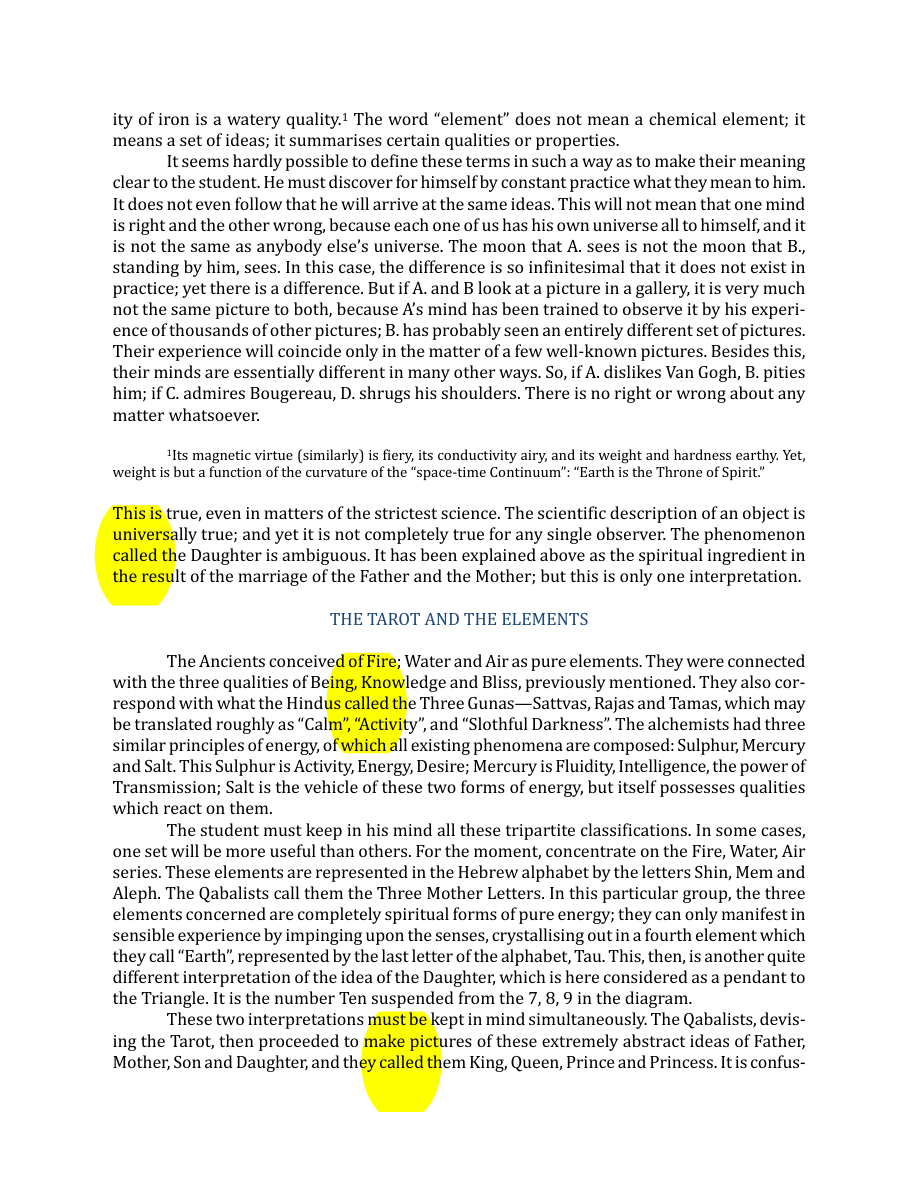
Highlights use the original PDF text layer. OCR-only matches may not be visible on the scan.
Transcription
Download text ↓raw extractionoriginal embedded textReview: unreviewed
ity of iron is a watery quality.1 The word “element” does not mean a chemical element; it
means a set of ideas; it summarises certain qualities or properties.
It seems hardly possible to define these terms in such a way as to make their meaning
clear to the student. He must discover for himself by constant practice what they mean to him.
It does not even follow that he will arrive at the same ideas. This will not mean that one mind
is right and the other wrong, because each one of us has his own universe all to himself, and it
is not the same as anybody else’s universe. The moon that A. sees is not the moon that B.,
standing by him, sees. In this case, the difference is so infinitesimal that it does not exist in
practice; yet there is a difference. But if A. and B look at a picture in a gallery, it is very much
not the same picture to both, because A’s mind has been trained to observe it by his experi‐
ence of thousands of other pictures; B. has probably seen an entirely different set of pictures.
Their experience will coincide only in the matter of a few well‐known pictures. Besides this,
their minds are essentially different in many other ways. So, if A. dislikes Van Gogh, B. pities
him; if C. admires Bougereau, D. shrugs his shoulders. There is no right or wrong about any
matter whatsoever.
1Its magnetic virtue (similarly) is fiery, its conductivity airy, and its weight and hardness earthy. Yet,
weight is but a function of the curvature of the “space‐time Continuum”: “Earth is the Throne of Spirit.”
This is true, even in matters of the strictest science. The scientific description of an object is
universally true; and yet it is not completely true for any single observer. The phenomenon
called the Daughter is ambiguous. It has been explained above as the spiritual ingredient in
the result of the marriage of the Father and the Mother; but this is only one interpretation.
THE TAROT AND THE ELEMENTS
The Ancients conceived of Fire; Water and Air as pure elements. They were connected
with the three qualities of Being, Knowledge and Bliss, previously mentioned. They also cor‐
respond with what the Hindus called the Three Gunas—Sattvas, Rajas and Tamas, which may
be translated roughly as “Calm”, “Activity”, and “Slothful Darkness”. The alchemists had three
similar principles of energy, of which all existing phenomena are composed: Sulphur, Mercury
and Salt. This Sulphur is Activity, Energy, Desire; Mercury is Fluidity, Intelligence, the power of
Transmission; Salt is the vehicle of these two forms of energy, but itself possesses qualities
which react on them.
The student must keep in his mind all these tripartite classifications. In some cases,
one set will be more useful than others. For the moment, concentrate on the Fire, Water, Air
series. These elements are represented in the Hebrew alphabet by the letters Shin, Mem and
Aleph. The Qabalists call them the Three Mother Letters. In this particular group, the three
elements concerned are completely spiritual forms of pure energy; they can only manifest in
sensible experience by impinging upon the senses, crystallising out in a fourth element which
they call “Earth”, represented by the last letter of the alphabet, Tau. This, then, is another quite
different interpretation of the idea of the Daughter, which is here considered as a pendant to
the Triangle. It is the number Ten suspended from the 7, 8, 9 in the diagram.
These two interpretations must be kept in mind simultaneously. The Qabalists, devis‐
ing the Tarot, then proceeded to make pictures of these extremely abstract ideas of Father,
Mother, Son and Daughter, and they called them King, Queen, Prince and Princess. It is confus‐
Page provenance & review flags
Stable page ID: c2293fa5b8d18e0cf1f666dc:p00024
Line breaks are preserved. Reading order and OCR accuracy may need review.
Printed page label has not been verified.
- legacy text differs review