1913 · CLOSE READING
Book 4 (Part II)
Book 4 (Part II) (1913), PDF p. 137
Original page
Enlarge ↗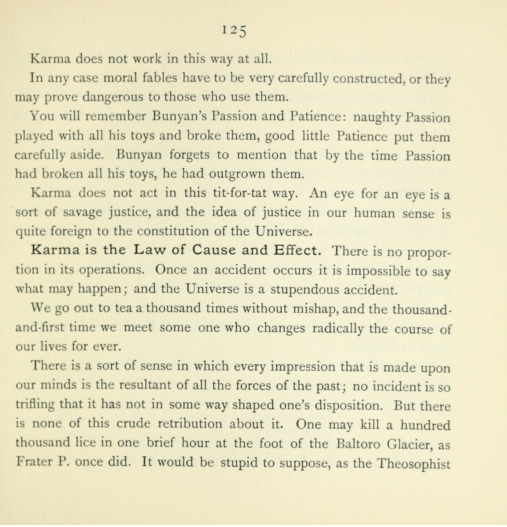
Highlights use the original PDF text layer. OCR-only matches may not be visible on the scan.
Transcription
Download text ↓raw extractionoriginal embedded textReview: unreviewed
125
Karma does not work
in this way at all.
In any case moral
fables have to be very carefully
constructed,
or they
may prove dangerous
to those who use them.
You will remember
Bunyan's
Passion
and Patience:
naughty
Passion
played
with all his toys and broke
them, good
little Patience
put
them
carefully
aside.
Bunyan
forgets
to
mention
that
by the
time
Passion
had broken
all his toys, he had outgrown
them.
Karma does
not
act
in
this
tit-for-tat
way.
An
eye for
an eye is a
sort of savage justice,
and
the
idea of justice
in
our
human
sense
is
quite foreign
to the constitution
of the Universe.
Karma is the Law of Cause and Effect.
There is no propor-
tion in its operations.
Once
an
accident
occurs
it is impossible
to say
what may happen ; and the Universe is a stupendous
accident.
We go out to tea a thousand
times without
mishap, and the thousand-
and-first
time we meet
some
one who
changes
radically
the course
of
our lives for ever.
There is a sort of sense in which
every impression
that
is made upon
our minds
is the resultant
of all the forces of the past;
no incident
is so
trifling
that it has not in some way shaped
one's disposition.
But there
is
none
of this
crude
retribution
about
it.
One
may kill
a
hundred
thousand
lice in one brief hour
at
the
foot
of the
Baltoro Glacier,
as
Prater
P. once did.
It would
be
stupid
to suppose,
as the Theosophist
Page provenance & review flags
Stable page ID: c96b4a13199c68ca1345dc34:p00137
Line breaks are preserved. Reading order and OCR accuracy may need review.
Printed page label has not been verified.
- No automated review flags. This does not establish transcription accuracy.