1907 · CLOSE READING
The Star in the West
The Star in the West (1907), PDF p. 295
Original page
Enlarge ↗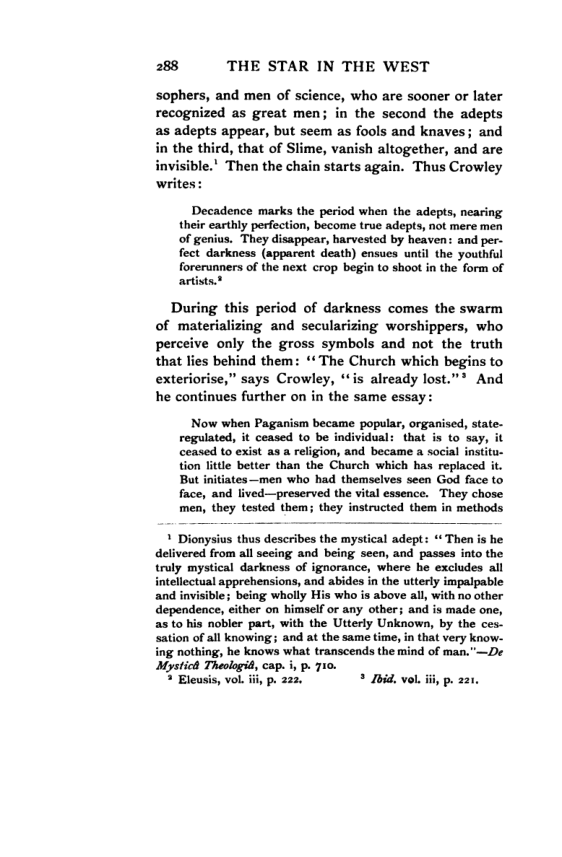
Highlights use the original PDF text layer. OCR-only matches may not be visible on the scan.
Transcription
Download text ↓raw extractionoriginal embedded textReview: unreviewed
288
THE STAR IN THE WEST
sophers , and men of science , who are sooner or later
recognized
as great
men ;
in
the
second
the adepts
as adepts appear , but seem as fools and knaves ; and
in the third , that of Slime , vanish altogether , and are
invisible . ' Then the chain starts again . Thus Crowley
writes :
Decadence marks the period when
the
adepts , nearing
their earthly perfection, become
true adepts , not mere men
of genius. They disappear , harvested
by heaven
: and per
fect darkness
( apparent
death ) ensues
until
the youthful
forerunners of the next crop begin to shoot
in the
form of
artists .?
During this period of darkness
comes the swarm
of
materializing
and
secularizing
worshippers , who
perceive only
the
gross
symbols
and not
the
truth
that lies behind them :
“
The Church which begins to
exteriorise ,” says Crowley ,
“ is already lost.”
And
he continues further on in the same
essay
:
Now when
Paganism became
popular , organised , state
regulated , it ceased
to
be individual :
that
is
to
say, it
ceased
to exist as a religion , and became
a social institu
tion little
better
than
the
Church which
has
replaced
it .
But initiates -men who had themselves
seen God face to
face , and lived
-- preserved
the vital essence .
They chose
men , they
tested
them ; they instructed
them
in methods
Dionysius
thus describes the mystical adept : “
Then is he
delivered from
all
seeing and being seen
,
and passes
into the
truly mystical
darkness
of
ignorance
,
where
he
excludes
all
intellectual apprehensions
,
and abides
in
the utterly impalpable
and invisible
;
being wholly His who
is
above
all
,
with
no
other
dependence
,
either
on
himself
or
any other
;
and
is
made
one
,
as
to
his nobler part
,
with
the
Utterly Unknown
,
by
the ces
sation
of
all
knowing
;
and
at
the same time
,
in
that very know
ing nothing
,
he
knows what transcends the mind
of
man
.”—
De
Mysticâ
Theologiâ
,
cap
.
i,
p
.
710
.
2
Eleusis
,
vol
.
iii,
p
.
222
,
3
Ibid
.
vol
.
iii,
p
.
221
,
Page provenance & review flags
Stable page ID: cbb8a01aa468b5fc3df19238:p00295
Line breaks are preserved. Reading order and OCR accuracy may need review.
Printed page label has not been verified.
- No automated review flags. This does not establish transcription accuracy.