1904 · CLOSE READING
The Sword of Song
The Sword of Song (1904), PDF p. 112
Original page
Enlarge ↗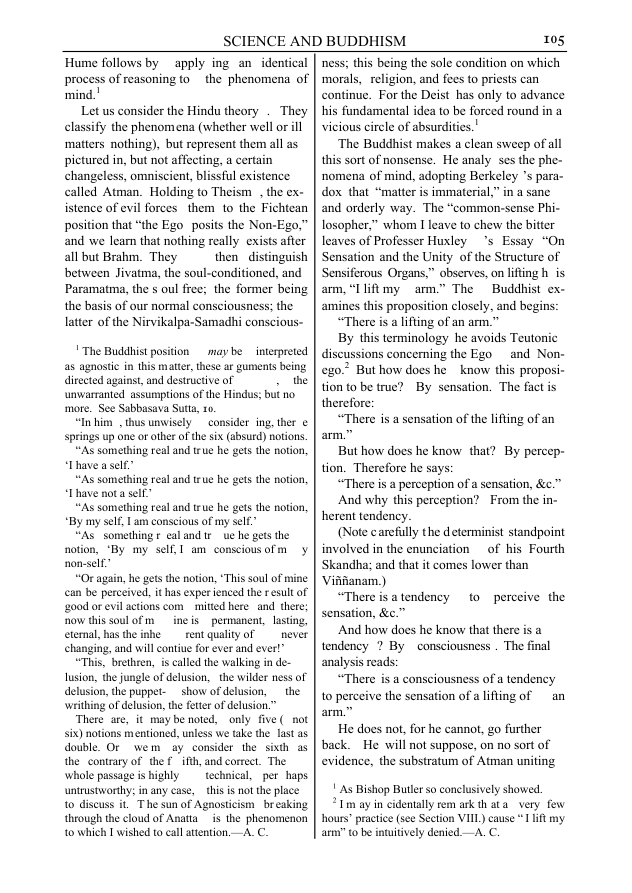
Highlights use the original PDF text layer. OCR-only matches may not be visible on the scan.
Transcription
Download text ↓raw extractionoriginal embedded textReview: unreviewed
SCIENCE AND BUDDHISM
105
Hume follows by
apply ing an identical
process of reasoning to
the phenomena of
mind.1
Let us consider the Hindu theory . They
classify the phenomena (whether well or ill
matters nothing), but represent them all as
pictured in, but not affecting, a certain
changeless, omniscient, blissful existence
called Atman. Holding to Theism , the ex-
istence of evil forces them to the Fichtean
position that “the Ego posits the Non-Ego,”
and we learn that nothing really exists after
all but Brahm. They
then distinguish
between Jivatma, the soul-conditioned, and
Paramatma, the s oul free; the former being
the basis of our normal consciousness; the
latter of the Nirvikalpa-Samadhi conscious-
1 The Buddhist position
may be
interpreted
as agnostic in this matter, these ar guments being
directed against, and destructive of
,
the
unwarranted assumptions of the Hindus; but no
more. See Sabbasava Sutta, 10.
“In him , thus unwisely
consider ing, ther e
springs up one or other of the six (absurd) notions.
“As something real and true he gets the notion,
‘I have a self.’
“As something real and true he gets the notion,
‘I have not a self.’
“As something real and true he gets the notion,
‘By my self, I am conscious of my self.’
“As something r eal and tr
ue he gets the
notion, ‘By my self, I am conscious of m
y
non-self.’
“Or again, he gets the notion, ‘This soul of mine
can be perceived, it has exper ienced the r esult of
good or evil actions com
mitted here and there;
now this soul of m
ine is permanent, lasting,
eternal, has the inhe
rent quality of
never
changing, and will contiue for ever and ever!’
“This, brethren, is called the walking in de-
lusion, the jungle of delusion, the wilder ness of
delusion, the puppet-
show of delusion,
the
writhing of delusion, the fetter of delusion.”
There are, it may be noted, only five ( not
six) notions mentioned, unless we take the last as
double. Or
we m
ay consider the sixth as
the contrary of the f
ifth, and correct. The
whole passage is highly
technical, per haps
untrustworthy; in any case, this is not the place
to discuss it. T he sun of Agnosticism br eaking
through the cloud of Anatta
is the phenomenon
to which I wished to call attention.—A. C.
ness; this being the sole condition on which
morals, religion, and fees to priests can
continue. For the Deist has only to advance
his fundamental idea to be forced round in a
vicious circle of absurdities.1
The Buddhist makes a clean sweep of all
this sort of nonsense. He analy ses the phe-
nomena of mind, adopting Berkeley ’s para-
dox that “matter is immaterial,” in a sane
and orderly way. The “common-sense Phi-
losopher,” whom I leave to chew the bitter
leaves of Professer Huxley
’s Essay “On
Sensation and the Unity of the Structure of
Sensiferous Organs,” observes, on lifting h is
arm, “I lift my
arm.” The
Buddhist ex-
amines this proposition closely, and begins:
“There is a lifting of an arm.”
By this terminology he avoids Teutonic
discussions concerning the Ego
and Non-
ego.2 But how does he know this proposi-
tion to be true? By sensation. The fact is
therefore:
“There is a sensation of the lifting of an
arm.”
But how does he know that? By percep-
tion. Therefore he says:
“There is a perception of a sensation, &c.”
And why this perception? From the in-
herent tendency.
(Note carefully the determinist standpoint
involved in the enunciation
of his Fourth
Skandha; and that it comes lower than
Viññanam.)
“There is a tendency
to perceive the
sensation, &c.”
And how does he know that there is a
tendency ? By consciousness . The final
analysis reads:
“There is a consciousness of a tendency
to perceive the sensation of a lifting of
an
arm.”
He does not, for he cannot, go further
back. He will not suppose, on no sort of
evidence, the substratum of Atman uniting
1 As Bishop Butler so conclusively showed.
2 I m ay in cidentally rem ark th at a very few
hours’ practice (see Section VIII.) cause “ I lift my
arm” to be intuitively denied.—A. C.
Page provenance & review flags
Stable page ID: cdd842c2ae8f5d9753c40b33:p00112
Line breaks are preserved. Reading order and OCR accuracy may need review.
Printed page label has not been verified.
- No automated review flags. This does not establish transcription accuracy.