1904 · CLOSE READING
The Sword of Song
The Sword of Song (1904), PDF p. 5
Original page
Enlarge ↗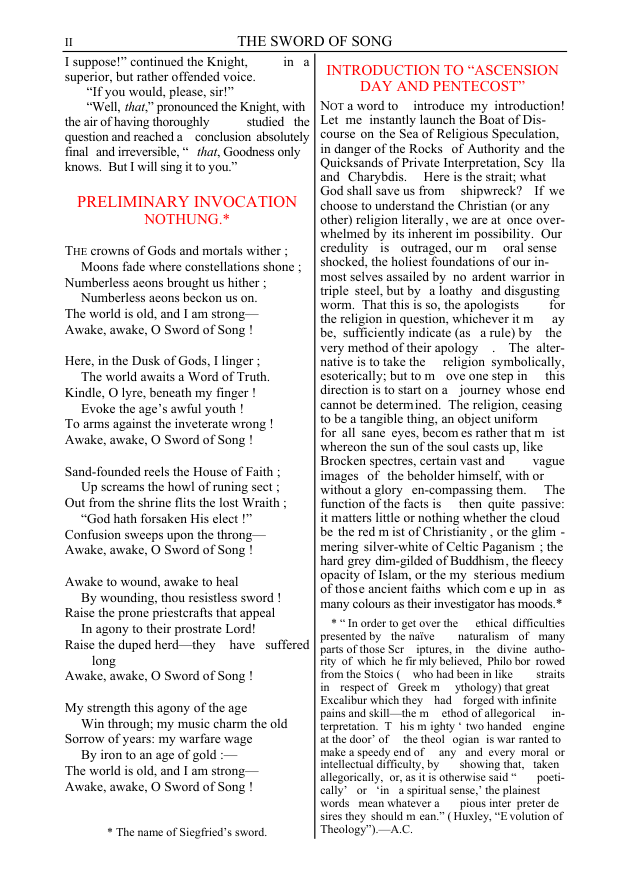
Highlights use the original PDF text layer. OCR-only matches may not be visible on the scan.
Transcription
Download text ↓raw extractionoriginal embedded textReview: unreviewed
THE SWORD OF SONG
II
I suppose!” continued the Knight,
in a
superior, but rather offended voice.
“If you would, please, sir!”
“Well, that,” pronounced the Knight, with
the air of having thoroughly
studied the
question and reached a conclusion absolutely
final and irreversible, “ that, Goodness only
knows. But I will sing it to you.”
PRELIMINARY INVOCATION
NOTHUNG.*
THE crowns of Gods and mortals wither ;
Moons fade where constellations shone ;
Numberless aeons brought us hither ;
Numberless aeons beckon us on.
The world is old, and I am strong—
Awake, awake, O Sword of Song !
Here, in the Dusk of Gods, I linger ;
The world awaits a Word of Truth.
Kindle, O lyre, beneath my finger !
Evoke the age’s awful youth !
To arms against the inveterate wrong !
Awake, awake, O Sword of Song !
Sand-founded reels the House of Faith ;
Up screams the howl of runing sect ;
Out from the shrine flits the lost Wraith ;
“God hath forsaken His elect !”
Confusion sweeps upon the throng—
Awake, awake, O Sword of Song !
Awake to wound, awake to heal
By wounding, thou resistless sword !
Raise the prone priestcrafts that appeal
In agony to their prostrate Lord!
Raise the duped herd—they have suffered
long
Awake, awake, O Sword of Song !
My strength this agony of the age
Win through; my music charm the old
Sorrow of years: my warfare wage
By iron to an age of gold :—
The world is old, and I am strong—
Awake, awake, O Sword of Song !
* The name of Siegfried’s sword.
INTRODUCTION TO “ASCENSION
DAY AND PENTECOST”
NOT a word to
introduce my introduction!
Let me instantly launch the Boat of Dis-
course on the Sea of Religious Speculation,
in danger of the Rocks of Authority and the
Quicksands of Private Interpretation, Scy lla
and Charybdis. Here is the strait; what
God shall save us from
shipwreck? If we
choose to understand the Christian (or any
other) religion literally, we are at once over-
whelmed by its inherent im possibility. Our
credulity is outraged, our m
oral sense
shocked, the holiest foundations of our in-
most selves assailed by no ardent warrior in
triple steel, but by a loathy and disgusting
worm. That this is so, the apologists
for
the religion in question, whichever it m
ay
be, sufficiently indicate (as a rule) by the
very method of their apology
. The alter-
native is to take the
religion symbolically,
esoterically; but to m
ove one step in
this
direction is to start on a journey whose end
cannot be determined. The religion, ceasing
to be a tangible thing, an object uniform
for all sane eyes, becom es rather that m ist
whereon the sun of the soul casts up, like
Brocken spectres, certain vast and
vague
images of the beholder himself, with or
without a glory en-compassing them. The
function of the facts is
then quite passive:
it matters little or nothing whether the cloud
be the red m ist of Christianity , or the glim -
mering silver-white of Celtic Paganism ; the
hard grey dim-gilded of Buddhism, the fleecy
opacity of Islam, or the my sterious medium
of those ancient faiths which com e up in as
many colours as their investigator has moods.*
* “ In order to get over the
ethical difficulties
presented by the naïve
naturalism of many
parts of those Scr
iptures, in the divine autho-
rity of which he fir mly believed, Philo bor rowed
from the Stoics (
who had been in like
straits
in respect of Greek m
ythology) that great
Excalibur which they had forged with infinite
pains and skill—the m
ethod of allegorical
in-
terpretation. T his m ighty ‘ two handed engine
at the door’ of
the theol ogian is war ranted to
make a speedy end of
any and every moral or
intellectual difficulty, by
showing that, taken
allegorically, or, as it is otherwise said “
poeti-
cally’ or ‘in a spiritual sense,’ the plainest
words mean whatever a
pious inter preter de
sires they should m ean.” ( Huxley, “E volution of
Theology”).—A.C.
Page provenance & review flags
Stable page ID: cdd842c2ae8f5d9753c40b33:p00005
Line breaks are preserved. Reading order and OCR accuracy may need review.
Printed page label has not been verified.
- No automated review flags. This does not establish transcription accuracy.