1904 · CLOSE READING
The Sword of Song
The Sword of Song (1904), PDF p. 71
Original page
Enlarge ↗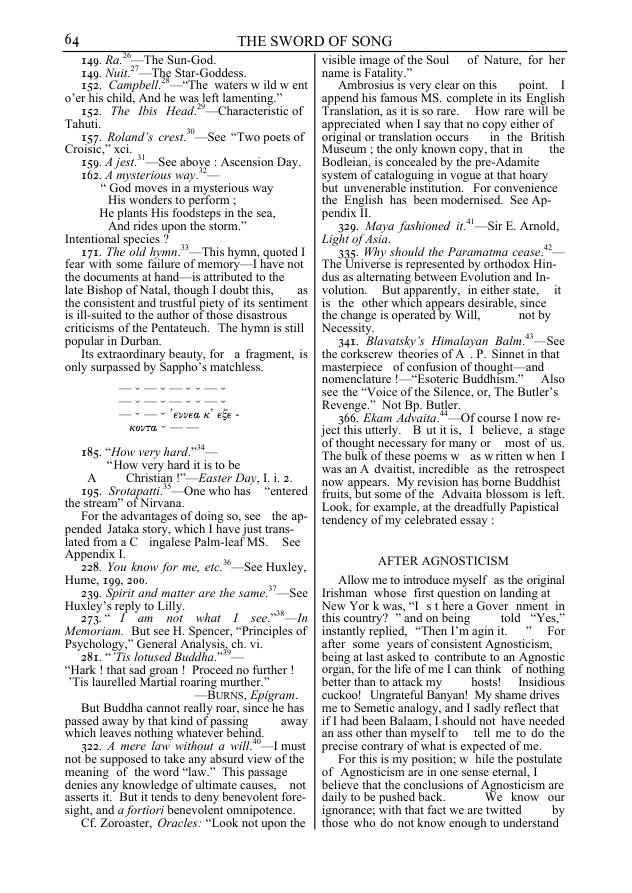
Highlights use the original PDF text layer. OCR-only matches may not be visible on the scan.
Transcription
Download text ↓raw extractionoriginal embedded textReview: unreviewed
THE SWORD OF SONG
64
149. Ra.26—The Sun-God.
149. Nuit.27—The Star-Goddess.
152. Campbell.28—“The waters w ild w ent
o’er his child, And he was left lamenting.”
152. The Ibis Head.29—Characteristic of
Tahuti.
157. Rolands crest.30—See “Two poets of
Croisic,” xci.
159. A jest.31—See above : Ascension Day.
162. A mysterious way.32—
“ God moves in a mysterious way
His wonders to perform ;
He plants His foodsteps in the sea,
And rides upon the storm.”
Intentional species ?
171. The old hymn.33—This hymn, quoted I
fear with some failure of memory—I have not
the documents at hand—is attributed to the
late Bishop of Natal, though I doubt this,
as
the consistent and trustful piety of its sentiment
is ill-suited to the author of those disastrous
criticisms of the Pentateuch. The hymn is still
popular in Durban.
Its extraordinary beauty, for a fragment, is
only surpassed by Sappho’s matchless.
— ! — ! — ! ! — !
— ! — ! — ! ! — !
— ! — ! 'ennea k' exe -
konta ! — —
185. “How very hard.”34—
“ How very hard it is to be
A
Christian !”—Easter Day, I. i. 2.
195. Srotapatti.35—One who has
“entered
the stream” of Nirvana.
For the advantages of doing so, see the ap-
pended Jataka story, which I have just trans-
lated from a C
ingalese Palm-leaf MS. See
Appendix I.
228. You know for me, etc.36—See Huxley,
Hume, 199, 200.
239. Spirit and matter are the same.37—See
Huxley’s reply to Lilly.
273. “ I am not what I see.”38—In
Memoriam. But see H. Spencer, “Principles of
Psychology,” General Analysis, ch. vi.
281. “Tis lotused Buddha.”39—
“Hark ! that sad groan ! Proceed no further !
’Tis laurelled Martial roaring murther.”
—BURNS, Epigram.
But Buddha cannot really roar, since he has
passed away by that kind of passing
away
which leaves nothing whatever behind.
322. A mere law without a will.40—I must
not be supposed to take any absurd view of the
meaning of the word “law.” This passage
denies any knowledge of ultimate causes, not
asserts it. But it tends to deny benevolent fore-
sight, and a fortiori benevolent omnipotence.
Cf. Zoroaster, Oracles: “Look not upon the
visible image of the Soul
of Nature, for her
name is Fatality.”
Ambrosius is very clear on this
point. I
append his famous MS. complete in its English
Translation, as it is so rare. How rare will be
appreciated when I say that no copy either of
original or translation occurs
in the British
Museum ; the only known copy, that in
the
Bodleian, is concealed by the pre-Adamite
system of cataloguing in vogue at that hoary
but unvenerable institution. For convenience
the English has been modernised. See Ap-
pendix II.
329. Maya fashioned it.41—Sir E. Arnold,
Light of Asia.
335. Why should the Paramatma cease.42—
The Universe is represented by orthodox Hin-
dus as alternating between Evolution and In-
volution. But apparently, in either state,
it
is the other which appears desirable, since
the change is operated by Will,
not by
Necessity.
341. Blavatskys Himalayan Balm.43—See
the corkscrew theories of A . P. Sinnet in that
masterpiece of confusion of thought—and
nomenclature !—“Esoteric Buddhism.”
Also
see the “Voice of the Silence, or, The Butler’s
Revenge.” Not Bp. Butler.
366. Ekam Advaita.44—Of course I now re-
ject this utterly. B ut it is, I believe, a stage
of thought necessary for many or
most of us.
The bulk of these poems w
as w ritten w hen I
was an A dvaitist, incredible as the retrospect
now appears. My revision has borne Buddhist
fruits, but some of the Advaita blossom is left.
Look, for example, at the dreadfully Papistical
tendency of my celebrated essay :
AFTER AGNOSTICISM
Allow me to introduce myself as the original
Irishman whose first question on landing at
New Yor k was, “I s t here a Gover nment in
this country? ” and on being
told “Yes,”
instantly replied, “Then I’m agin it.
” For
after some years of consistent Agnosticism,
being at last asked to contribute to an Agnostic
organ, for the life of me I can think of nothing
better than to attack my
hosts! Insidious
cuckoo! Ungrateful Banyan! My shame drives
me to Semetic analogy, and I sadly reflect that
if I had been Balaam, I should not have needed
an ass other than myself to
tell me to do the
precise contrary of what is expected of me.
For this is my position; w hile the postulate
of Agnosticism are in one sense eternal, I
believe that the conclusions of Agnosticism are
daily to be pushed back.
We know our
ignorance; with that fact we are twitted
by
those who do not know enough to understand
Page provenance & review flags
Stable page ID: cdd842c2ae8f5d9753c40b33:p00071
Line breaks are preserved. Reading order and OCR accuracy may need review.
Printed page label has not been verified.
- legacy text differs review