1904 · CLOSE READING
The Sword of Song
The Sword of Song (1904), PDF p. 79
Original page
Enlarge ↗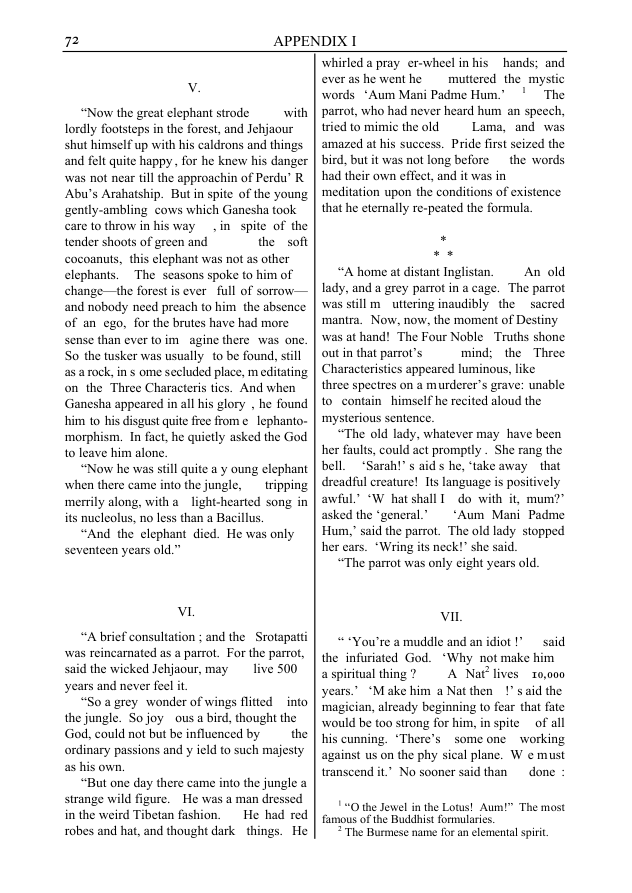
Highlights use the original PDF text layer. OCR-only matches may not be visible on the scan.
Transcription
Download text ↓raw extractionoriginal embedded textReview: unreviewed
APPENDIX I
72
V.
“Now the great elephant strode
with
lordly footsteps in the forest, and Jehjaour
shut himself up with his caldrons and things
and felt quite happy, for he knew his danger
was not near till the approachin of Perdu’ R
Abu’s Arahatship. But in spite of the young
gently-ambling cows which Ganesha took
care to throw in his way
, in spite of the
tender shoots of green and
the soft
cocoanuts, this elephant was not as other
elephants. The seasons spoke to him of
change—the forest is ever full of sorrow—
and nobody need preach to him the absence
of an ego, for the brutes have had more
sense than ever to im agine there was one.
So the tusker was usually to be found, still
as a rock, in s ome secluded place, m editating
on the Three Characteris tics. And when
Ganesha appeared in all his glory , he found
him to his disgust quite free from e lephanto-
morphism. In fact, he quietly asked the God
to leave him alone.
“Now he was still quite a y oung elephant
when there came into the jungle,
tripping
merrily along, with a light-hearted song in
its nucleolus, no less than a Bacillus.
“And the elephant died. He was only
seventeen years old.”
VI.
“A brief consultation ; and the Srotapatti
was reincarnated as a parrot. For the parrot,
said the wicked Jehjaour, may
live 500
years and never feel it.
“So a grey wonder of wings flitted
into
the jungle. So joy
ous a bird, thought the
God, could not but be influenced by
the
ordinary passions and y ield to such majesty
as his own.
“But one day there came into the jungle a
strange wild figure. He was a man dressed
in the weird Tibetan fashion.
He had red
robes and hat, and thought dark things. He
whirled a pray er-wheel in his
hands; and
ever as he went he
muttered the mystic
words ‘Aum Mani Padme Hum.’
1 The
parrot, who had never heard hum an speech,
tried to mimic the old
Lama, and was
amazed at his success. Pride first seized the
bird, but it was not long before
the words
had their own effect, and it was in
meditation upon the conditions of existence
that he eternally re-peated the formula.
*
* *
“A home at distant Inglistan.
An old
lady, and a grey parrot in a cage. The parrot
was still m
uttering inaudibly the
sacred
mantra. Now, now, the moment of Destiny
was at hand! The Four Noble Truths shone
out in that parrot’s
mind; the Three
Characteristics appeared luminous, like
three spectres on a murderer’s grave: unable
to contain himself he recited aloud the
mysterious sentence.
“The old lady, whatever may have been
her faults, could act promptly . She rang the
bell. ‘Sarah!’ s aid s he, ‘take away that
dreadful creature! Its language is positively
awful.’ ‘W hat shall I do with it, mum?’
asked the ‘general.’
‘Aum Mani Padme
Hum,’ said the parrot. The old lady stopped
her ears. ‘Wring its neck!’ she said.
“The parrot was only eight years old.
VII.
“ ‘You’re a muddle and an idiot !’
said
the infuriated God. ‘Why not make him
a spiritual thing ?
A Nat2 lives 10,000
years.’ ‘M ake him a Nat then !’ s aid the
magician, already beginning to fear that fate
would be too strong for him, in spite
of all
his cunning. ‘There’s some one working
against us on the phy sical plane. W e must
transcend it.’ No sooner said than
done :
1 “O the Jewel in the Lotus! Aum!” The most
famous of the Buddhist formularies.
2 The Burmese name for an elemental spirit.
Page provenance & review flags
Stable page ID: cdd842c2ae8f5d9753c40b33:p00079
Line breaks are preserved. Reading order and OCR accuracy may need review.
Printed page label has not been verified.
- legacy text differs review