1910 · CLOSE READING
The Equinox (Volume I, Number III)
The Equinox (Volume I, Number III) (1910), PDF p. 115
Original page
Enlarge ↗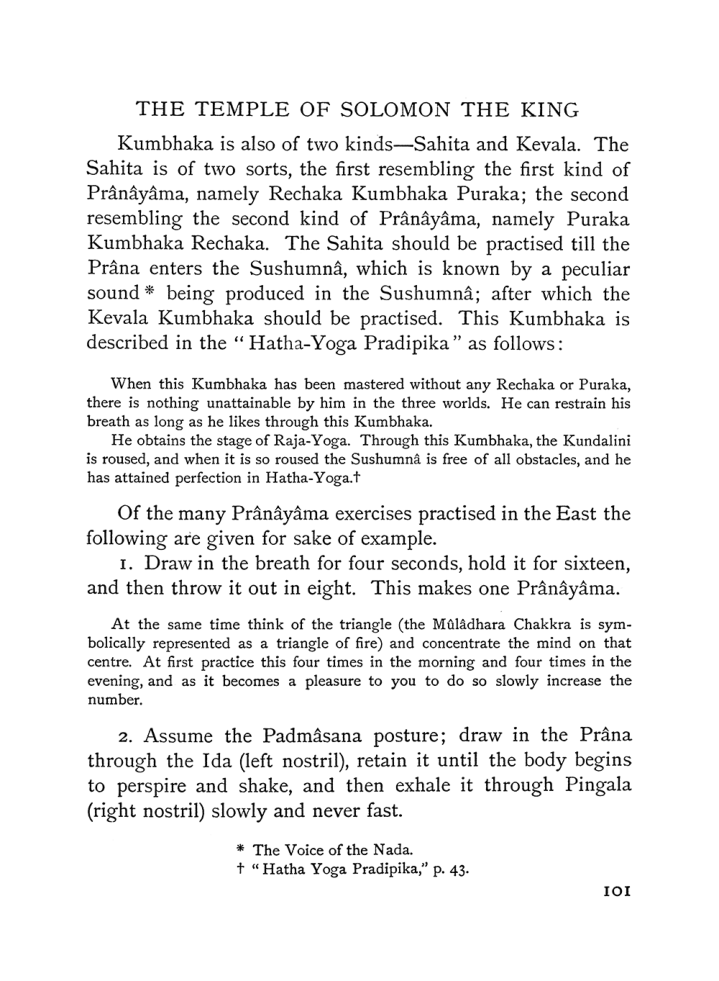
Highlights use the original PDF text layer. OCR-only matches may not be visible on the scan.
Transcription
Download text ↓raw extractionoriginal embedded textReview: unreviewed
THE TEMPLE OF SOLOMON THE KING
Kumbhaka is also of two kinds—Sahita and Kevala. The
Sahita is of two sorts, the first resembling the first kind of
Pranayama, namely Rechaka Kumbhaka Puraka; the second
resembling the second kind of Pranayama, namely Puraka
Kumbhaka Rechaka. The Sahita should be practised till the
Prana enters the Sushumna, which is known by a peculiar
sound* being produced in the Sushumné4; after which the
Kevala Kumbhaka should be practised. This Kumbhaka is
described in the “ Hatha-Yoga Pradipika” as follows:
When this Kumbhaka has been mastered without any Rechaka or Puraka,
there is nothing unattainable by him in the three worlds, He can restrain his
breath as long as he likes through this Kumbhaka.
He obtains the stage of Raja-Yoga. Through this Kumbhaka, the Kundalini
is roused, and when it is so roused the Sushumné is free of all obstacles, and he
has attained perfection in Hatha-Yoga.t
Of the many Prandy4ma exercises practised in the East the
following are given for sake of example.
1. Draw in the breath for four seconds, hold it for sixteen,
and then throw it out in eight. This makes one Pranayama.
At the same time think of the triangle (the Maladhara Chakkra is sym-
bolically represented as a triangle of fire) and concentrate the mind on that
centre. At first practice this four times in the morning and four times in the
evening, and as it becomes a pleasure to you to do so slowly increase the
number.
2. Assume the Padmdsana posture; draw in the Prana
through the Ida (left nostril), retain it until the body begins
to perspire and shake, and then exhale it through Pingala
(right nostril) slowly and never fast.
* The Voice of the Nada.
+ “Hatha Yoga Pradipika,” p. 43.
Iol
Page provenance & review flags
Stable page ID: d1f23c8ca1536b365e6ad0ea:p00115
Line breaks are preserved. Reading order and OCR accuracy may need review.
Printed page label has not been verified.
- No automated review flags. This does not establish transcription accuracy.