1954 · CLOSE READING
Magick Without Tears
Magick Without Tears (1954), PDF p. 166
Original page
Enlarge ↗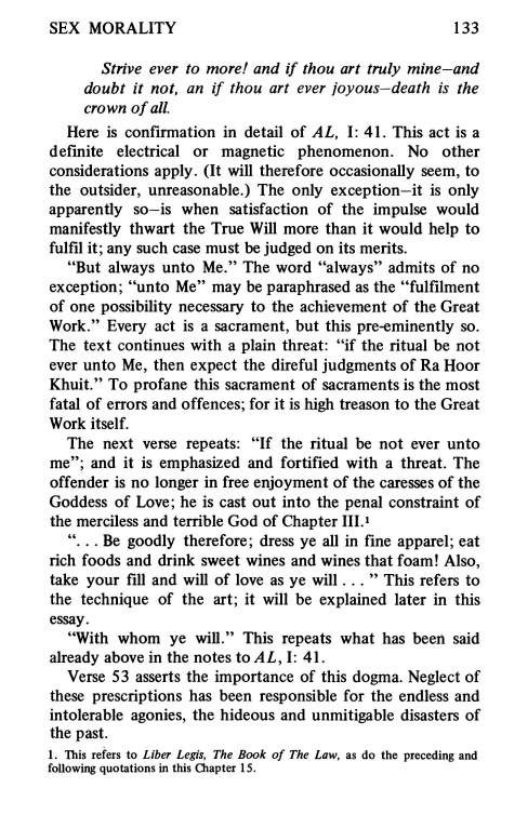
Highlights use the original PDF text layer. OCR-only matches may not be visible on the scan.
Transcription
Download text ↓raw extractionoriginal embedded textReview: unreviewed
SEX MORALITY
133
Strive ever to more! and if thou art truly mine-and
doubt it not, an if thou art ever joyous-death
is the
crown of all.
Here is confinnation in detail of AL, I: 41. This act is a
definite electrical or magnetic phenomenon.
No other
considerations apply. (It will therefore occasionally seem, to
the outsider, unreasonable.) The only exception-it is only
apparently so-is when satisfaction of the impulse would
manifestly thwart the True Will more than it would help to
fulfil it; any such case must be judged on its merits.
"But always unto Me." The word "always" admits of no
exception; "unto Me" may be paraphrased as the "fulfilment
of one possibility necessary to the achievement of the Great
Work." Every act is a sacrament, but this pre-eminently so.
The text continues with a plain threat: "if the ritual be not
ever unto Me, then expect the direful judgments of Ra Hoor
Khuit." To profane this sacrament of sacraments is the most
fatal of errors and offences; for it is high treason to the Great
Work itself.
The next verse repeats: "If the ritual be not ever unto
me"; and it is emphasized and fortified with a threat. The
offender is no longer in free enjoyment of the caresses of the
Goddess of Love; he is cast out into the penal constraint of
the merciless and terrible God of Chapter 111.1
" ... Be goodly therefore; dress ye all in fine apparel; eat
rich foods and drink sweet wines and wines that foam! Also,
take your fill and will of love as ye will ... " This refers to
the technique of the art; it will be explained later in this
essay.
"With whom ye will." This repeats what has been said
already above in the notes to AL, I: 41.
Verse 53 asserts the importance of this dogma. Neglect of
these prescriptions has been responsible for the endless and
intolerable agonies, the hideous and unmitigable disasters of
the past.
1. This refers to Liber Legis, The Book of The Law, as do the preceding and
following quotations in this Cllapter 15.
Page provenance & review flags
Stable page ID: e7a83bd7c68d4e96894f9e69:p00166
Line breaks are preserved. Reading order and OCR accuracy may need review.
Printed page label has not been verified.
- No automated review flags. This does not establish transcription accuracy.