1954 · CLOSE READING
Magick Without Tears
Magick Without Tears (1954), PDF p. 24
Original page
Enlarge ↗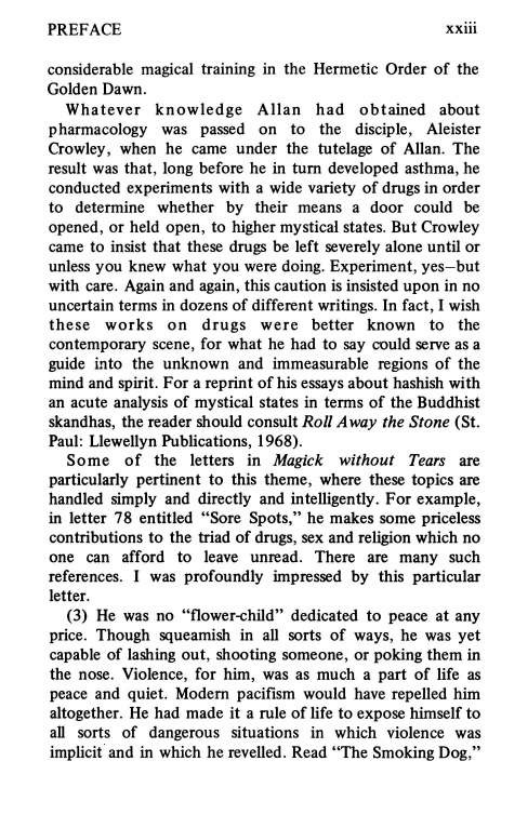
Highlights use the original PDF text layer. OCR-only matches may not be visible on the scan.
Transcription
Download text ↓raw extractionoriginal embedded textReview: unreviewed
PREFACE
XXlll
considerable magical training in the Hermetic Order of the
Golden Dawn.
Whatever
knowledge
Allan
had obtained
about
pharmacology was passed on to the disciple, Aleister
Crowley, when he came under the tutelage of Allan. The
result was that, long before he in turn developed asthma, he
conducted experiments with a wide variety of drugs in order
to determine whether by their means a door could be
opened, or held open, to higher mystical states. But Crowley
came to insist that these drugs be left severely alone until or
unless you knew what you were doing. Experiment, yes-but
with care. Again and again, this caution is insisted upon in no
uncertain terms in dozens of different writings. In fact, I wish
these
works
on drugs
were better known to the
contemporary scene, for what he had to say could serve as a
guide into the unknown and immeasurable regions of the
mind and spirit. For a reprint of his essays about hashish with
an acute analysis of mystical states in terms of the Buddhist
skandhas, the reader should consult Roll A way the Stone (St.
Paul: Llewellyn Publications, 1968).
Some of the letters in Magick without
Tears are
particularly pertinent to this theme, where these topics are
handled simply and directly and intelligently. For example,
in letter 78 entitled "Sore Spots," he makes some priceless
contributions to the triad of drugs, sex and religion which no
one can afford to leave unread. There are many such
references. I was profoundly impressed by this particular
letter.
(3) He was no "flower-child" dedicated to peace at any
price. Though squeamish in all sorts of ways, he was yet
capable of lashing out, shooting someone, or poking them in
the nose. Violence, for him, was as much a part of life as
peace and quiet. Modern pacifism would have repelled him
altogether. He had made it a rule of life to expose himself to
all sorts of dangerous situations in which violence was
implicit" and in which he revelled. Read "The Smoking Dog,"
Page provenance & review flags
Stable page ID: e7a83bd7c68d4e96894f9e69:p00024
Line breaks are preserved. Reading order and OCR accuracy may need review.
Printed page label has not been verified.
- No automated review flags. This does not establish transcription accuracy.