1954 · CLOSE READING
Magick Without Tears
Magick Without Tears (1954), PDF p. 419
Original page
Enlarge ↗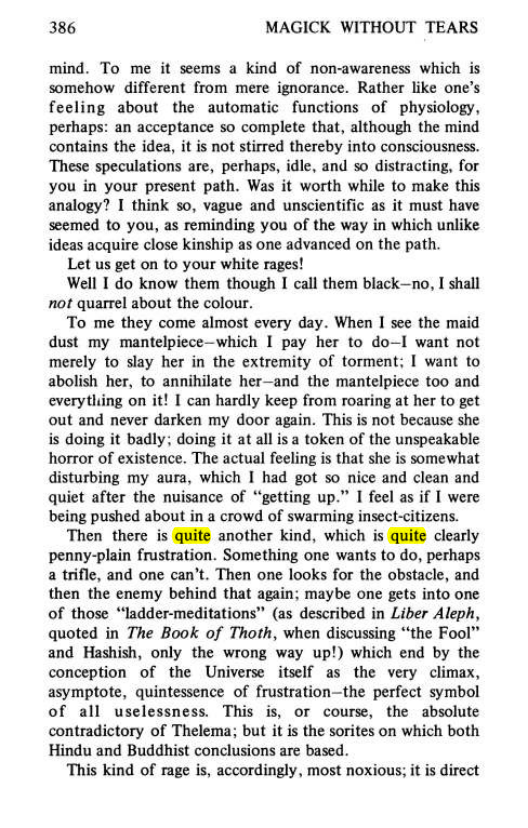
Highlights use the original PDF text layer. OCR-only matches may not be visible on the scan.
Transcription
Download text ↓raw extractionoriginal embedded textReview: unreviewed
386
MAGICK WITHOUT TEARS
mind. To me it seems a kind of non-awareness which is
somehow different from mere ignorance. Rather like one's
feeling
about
the automatic
functions of physiology,
perhaps: an acceptance so complete that, although the mind
contains the idea, it is not stirred thereby into consciousness.
These speculations are, perhaps, idle, amI so distracting, for
you in your present path. Was it worth while to make this
analogy? I think so, vague and unscientific as it must have
seemed to you, as reminding you of the way in which unlike
ideas acquire close kinship as one advanced on the path .
Let us get on to your white rages!
Well I do know them though I call them black-no, I shall
not quarrel about the colour.
To me they come almost every day. When I see the maid
dust my mantelpiece-which
I pay her to do-I want not
merely to slay her in the extremity of torment; I want to
abolish her, to annihilate her-and the mantelpiece too and
everything on it! I can hardly keep from roaring at her to get
out and never darken my door again. This is not because she
is doing it badly; doing it at all is a token of the unspeakable
horror of existence. The actual feeling is that she is somewhat
disturbing my aura, which I had got so nice and clean and
quiet after the nuisance of "getting up." I feel as if I were
being pushed about in a crowd of swarming insect-citizens.
Then there is quite another kind, which is quite clearly
penny-plain frustration. Something one wants to do, perhaps
a trifle, and one can't. Then one looks for the obstacle, and
then the enemy behind that again; maybe one gets into one
of those "ladder-meditations" (as described in Liber Aleph,
quoted in The Book of Thoth, when discussing "the Fool"
and Hashish, only the wrong way up!) which end by the
conception
of the Universe itself as the very climax,
asymptote, quintessence of frustration-the
perfect symbol
of all uselessness.
This is, or course, the absolute
contradictory of Thelema; but it is the sorites on which both
Hindu and Buddhist conclusions are based.
This kind of rage is, accordingly, most noxious; it is direct
Page provenance & review flags
Stable page ID: e7a83bd7c68d4e96894f9e69:p00419
Line breaks are preserved. Reading order and OCR accuracy may need review.
Printed page label has not been verified.
- No automated review flags. This does not establish transcription accuracy.