1954 · CLOSE READING
Magick Without Tears
Magick Without Tears (1954), PDF p. 440
Original page
Enlarge ↗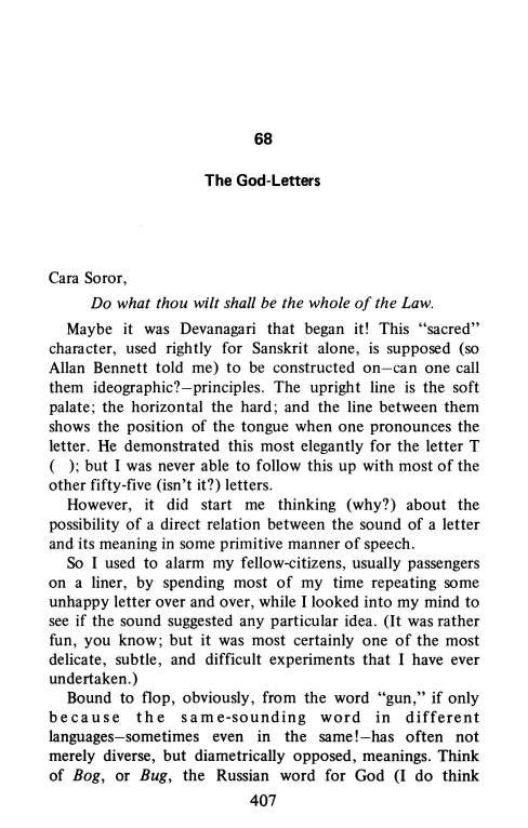
Highlights use the original PDF text layer. OCR-only matches may not be visible on the scan.
Transcription
Download text ↓raw extractionoriginal embedded textReview: unreviewed
68
The God-Letters
Cara Soror,
Do what thou wilt shall be the whole of the Law.
Maybe it was Devanagari that began it! This "sacred"
character , used rightly for Sanskrit alone , is supposed (so
Allan Bennett told me) to be constructed on-can one call
them ideographic?-principles.
The upright line is the soft
palate ; the horizontal the hard ; and the line between them
shows the position of the tongue when one pronounces the
letter. He demonstrated this most elegantly for the letter T
( ); but I was never able to follow this up with most of the
other fifty-five (isn't it?) letters .
However, it did start me thinking (why?) about the
possibility of a direct relation between the sound of a letter
and its meaning in some primitive manner of speech.
So I used to alarm my fellow-citizens , usually passengers
on a liner, by spending most of my time repeating some
unhappy letter over and over, while I looked into my mind to
see if the sound suggested any particular idea. (It was rather
fun, you know ; but it was most certainly one of the most
delicate , subtle , and difficult experiments that I have ever
undertaken .)
Bound to flop, obviously, from the word "gun," if only
because
the same-sounding
word
in different
languages-sometimes
even in the same!-has
often not
merely diverse, but diametrically opposed, meanings. Think
of Bog, or Bug, the Russian word for God (I do think
407
Page provenance & review flags
Stable page ID: e7a83bd7c68d4e96894f9e69:p00440
Line breaks are preserved. Reading order and OCR accuracy may need review.
Printed page label has not been verified.
- No automated review flags. This does not establish transcription accuracy.