1909 · CLOSE READING
The Soldier and the Hunchback ! and ?
The Soldier and the Hunchback ! and ? (1909), PDF p. 7
Original page
Enlarge ↗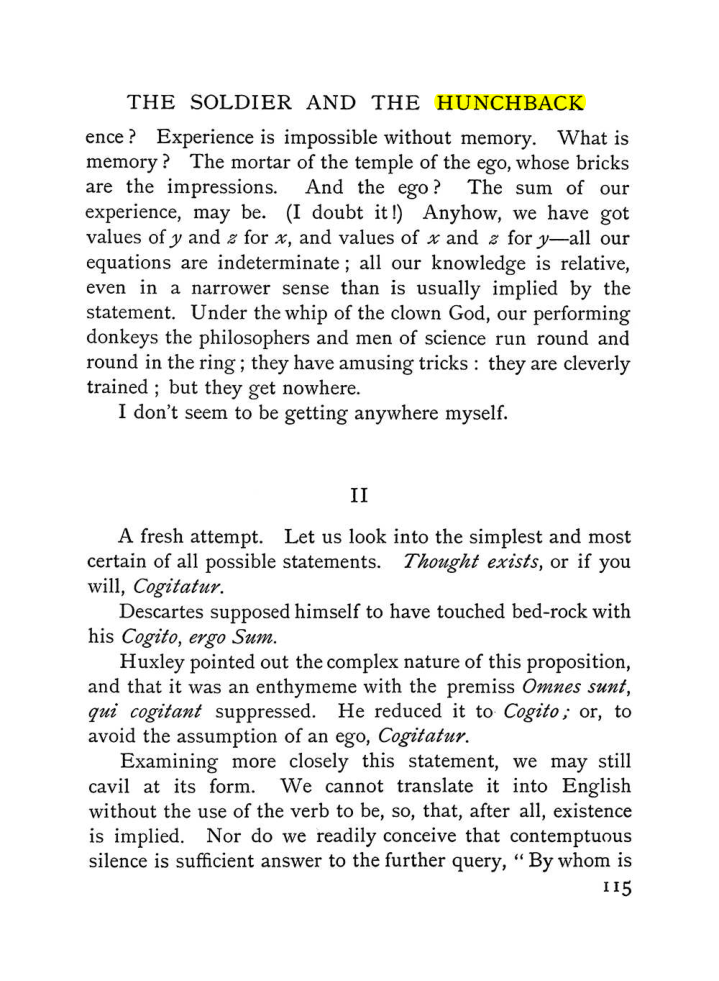
Highlights use the original PDF text layer. OCR-only matches may not be visible on the scan.
Transcription
Download text ↓raw extractionoriginal embedded textReview: unreviewed
THE SOLDIER AND THE HUNCHBACK
ence? Experience is impossible without memory. What is
memory? The mortar of the temple of the ego, whose bricks
are the impressions. And the ego? The sum of our
experience, may be. (I doubt it!) Anyhow, we have got
values of y and g for x, and values of ¥ and zg for y—all our
equations are indeterminate; all our knowledge is relative,
even in a narrower sense than is usually implied by the
statement. Under the whip of the clown God, our performing
donkeys the philosophers and men of science run round and
round in the ring; they have amusing tricks : they are cleverly
trained ; but they get nowhere.
I don’t seem to be getting anywhere myself.
II
A fresh attempt. Let us look into the simplest and most
certain of all possible statements. Thought exists, or if you
will, Cogitatur.
Descartes supposed himself to have touched bed-rock with
his Cogito, ergo Sum.
Huxley pointed out the complex nature of this proposition,
and that it was an enthymeme with the premiss Ommes sunt,
gui cogitant suppressed. He reduced it to Cogito, or, to
avoid the assumption of an ego, Cogitatur.
Examining more closely this statement, we may still
cavil at its form. We cannot translate it into English
without the use of the verb to be, so, that, after all, existence
is implied. Nor do we readily conceive that contemptuous
silence is sufficient answer to the further query, “ By whom is
115
Page provenance & review flags
Stable page ID: 183818ca354a4ac152edc4a7:p00007
Line breaks are preserved. Reading order and OCR accuracy may need review.
Printed page label has not been verified.
- No automated review flags. This does not establish transcription accuracy.