1929 · CLOSE READING
Confessions of Aleister Crowley
Confessions of Aleister Crowley (1929), PDF p. 283
Original page
Enlarge ↗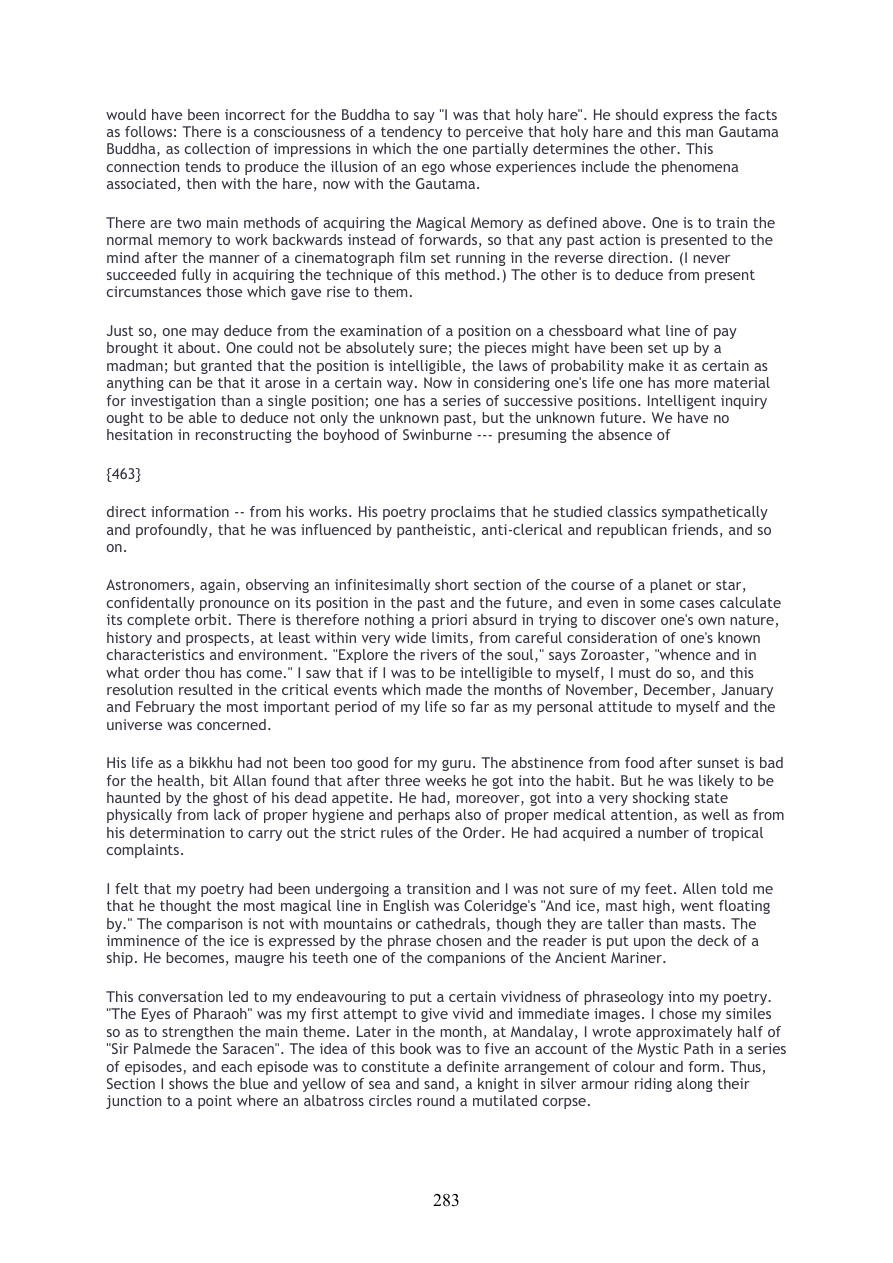
Highlights use the original PDF text layer. OCR-only matches may not be visible on the scan.
Transcription
Download text ↓raw extractionoriginal embedded textReview: unreviewed
283
would have been incorrect for the Buddha to say "I was that holy hare". He should express the facts
as follows: There is a consciousness of a tendency to perceive that holy hare and this man Gautama
Buddha, as collection of impressions in which the one partially determines the other. This
connection tends to produce the illusion of an ego whose experiences include the phenomena
associated, then with the hare, now with the Gautama.
There are two main methods of acquiring the Magical Memory as defined above. One is to train the
normal memory to work backwards instead of forwards, so that any past action is presented to the
mind after the manner of a cinematograph film set running in the reverse direction. (I never
succeeded fully in acquiring the technique of this method.) The other is to deduce from present
circumstances those which gave rise to them.
Just so, one may deduce from the examination of a position on a chessboard what line of pay
brought it about. One could not be absolutely sure; the pieces might have been set up by a
madman; but granted that the position is intelligible, the laws of probability make it as certain as
anything can be that it arose in a certain way. Now in considering one's life one has more material
for investigation than a single position; one has a series of successive positions. Intelligent inquiry
ought to be able to deduce not only the unknown past, but the unknown future. We have no
hesitation in reconstructing the boyhood of Swinburne --- presuming the absence of
{463}
direct information -- from his works. His poetry proclaims that he studied classics sympathetically
and profoundly, that he was influenced by pantheistic, anti-clerical and republican friends, and so
on.
Astronomers, again, observing an infinitesimally short section of the course of a planet or star,
confidentally pronounce on its position in the past and the future, and even in some cases calculate
its complete orbit. There is therefore nothing a priori absurd in trying to discover one's own nature,
history and prospects, at least within very wide limits, from careful consideration of one's known
characteristics and environment. "Explore the rivers of the soul," says Zoroaster, "whence and in
what order thou has come." I saw that if I was to be intelligible to myself, I must do so, and this
resolution resulted in the critical events which made the months of November, December, January
and February the most important period of my life so far as my personal attitude to myself and the
universe was concerned.
His life as a bikkhu had not been too good for my guru. The abstinence from food after sunset is bad
for the health, bit Allan found that after three weeks he got into the habit. But he was likely to be
haunted by the ghost of his dead appetite. He had, moreover, got into a very shocking state
physically from lack of proper hygiene and perhaps also of proper medical attention, as well as from
his determination to carry out the strict rules of the Order. He had acquired a number of tropical
complaints.
I felt that my poetry had been undergoing a transition and I was not sure of my feet. Allen told me
that he thought the most magical line in English was Coleridge's "And ice, mast high, went floating
by." The comparison is not with mountains or cathedrals, though they are taller than masts. The
imminence of the ice is expressed by the phrase chosen and the reader is put upon the deck of a
ship. He becomes, maugre his teeth one of the companions of the Ancient Mariner.
This conversation led to my endeavouring to put a certain vividness of phraseology into my poetry.
"The Eyes of Pharaoh" was my first attempt to give vivid and immediate images. I chose my similes
so as to strengthen the main theme. Later in the month, at Mandalay, I wrote approximately half of
"Sir Palmede the Saracen". The idea of this book was to five an account of the Mystic Path in a series
of episodes, and each episode was to constitute a definite arrangement of colour and form. Thus,
Section I shows the blue and yellow of sea and sand, a knight in silver armour riding along their
junction to a point where an albatross circles round a mutilated corpse.
Page provenance & review flags
Stable page ID: 5ef44b98d8f9c4af5f6f86e1:p00283
Line breaks are preserved. Reading order and OCR accuracy may need review.
Printed page label has not been verified.
- No automated review flags. This does not establish transcription accuracy.