1929 · CLOSE READING
Confessions of Aleister Crowley
Confessions of Aleister Crowley (1929), PDF p. 468
Original page
Enlarge ↗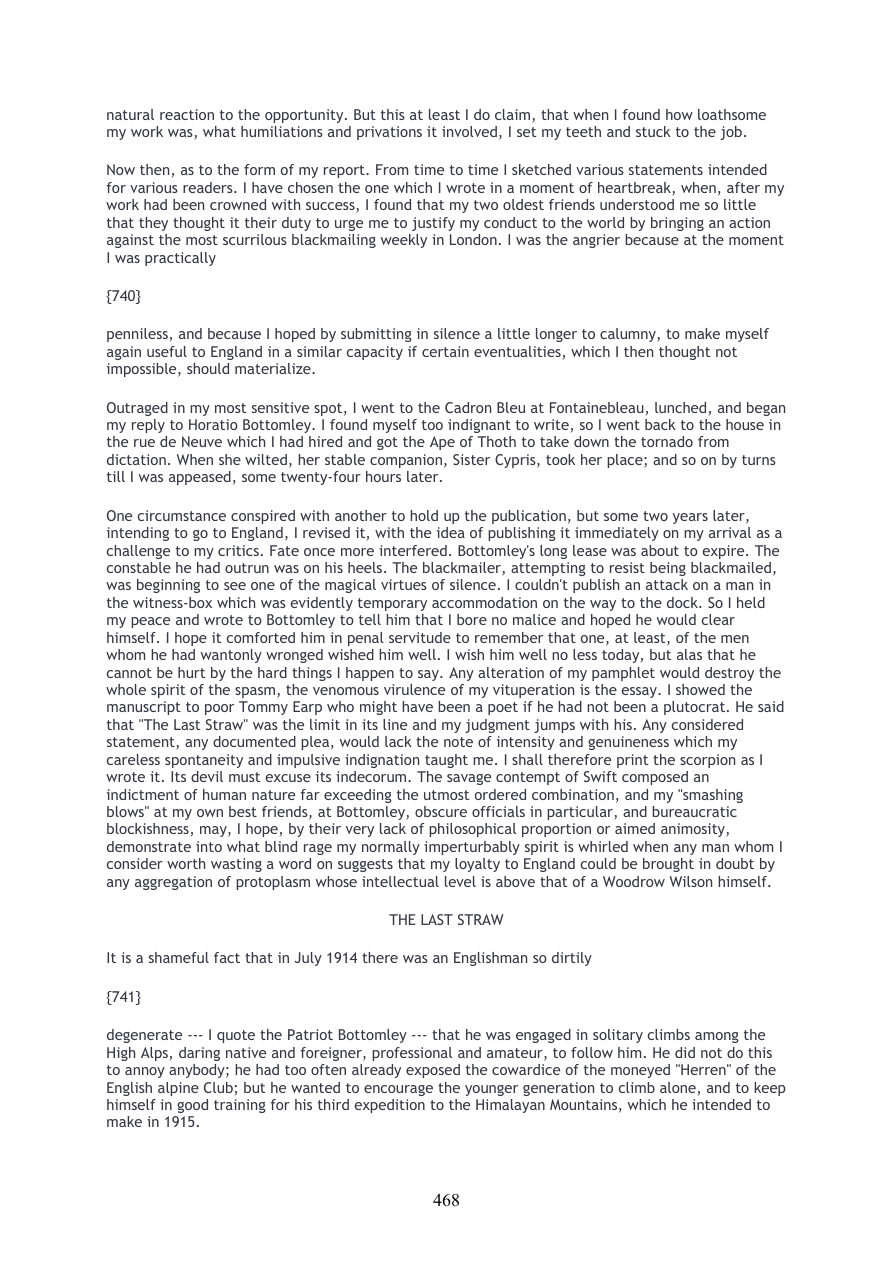
Highlights use the original PDF text layer. OCR-only matches may not be visible on the scan.
Transcription
Download text ↓raw extractionoriginal embedded textReview: unreviewed
468
natural reaction to the opportunity. But this at least I do claim, that when I found how loathsome
my work was, what humiliations and privations it involved, I set my teeth and stuck to the job.
Now then, as to the form of my report. From time to time I sketched various statements intended
for various readers. I have chosen the one which I wrote in a moment of heartbreak, when, after my
work had been crowned with success, I found that my two oldest friends understood me so little
that they thought it their duty to urge me to justify my conduct to the world by bringing an action
against the most scurrilous blackmailing weekly in London. I was the angrier because at the moment
I was practically
{740}
penniless, and because I hoped by submitting in silence a little longer to calumny, to make myself
again useful to England in a similar capacity if certain eventualities, which I then thought not
impossible, should materialize.
Outraged in my most sensitive spot, I went to the Cadron Bleu at Fontainebleau, lunched, and began
my reply to Horatio Bottomley. I found myself too indignant to write, so I went back to the house in
the rue de Neuve which I had hired and got the Ape of Thoth to take down the tornado from
dictation. When she wilted, her stable companion, Sister Cypris, took her place; and so on by turns
till I was appeased, some twenty-four hours later.
One circumstance conspired with another to hold up the publication, but some two years later,
intending to go to England, I revised it, with the idea of publishing it immediately on my arrival as a
challenge to my critics. Fate once more interfered. Bottomley's long lease was about to expire. The
constable he had outrun was on his heels. The blackmailer, attempting to resist being blackmailed,
was beginning to see one of the magical virtues of silence. I couldn't publish an attack on a man in
the witness-box which was evidently temporary accommodation on the way to the dock. So I held
my peace and wrote to Bottomley to tell him that I bore no malice and hoped he would clear
himself. I hope it comforted him in penal servitude to remember that one, at least, of the men
whom he had wantonly wronged wished him well. I wish him well no less today, but alas that he
cannot be hurt by the hard things I happen to say. Any alteration of my pamphlet would destroy the
whole spirit of the spasm, the venomous virulence of my vituperation is the essay. I showed the
manuscript to poor Tommy Earp who might have been a poet if he had not been a plutocrat. He said
that "The Last Straw" was the limit in its line and my judgment jumps with his. Any considered
statement, any documented plea, would lack the note of intensity and genuineness which my
careless spontaneity and impulsive indignation taught me. I shall therefore print the scorpion as I
wrote it. Its devil must excuse its indecorum. The savage contempt of Swift composed an
indictment of human nature far exceeding the utmost ordered combination, and my "smashing
blows" at my own best friends, at Bottomley, obscure officials in particular, and bureaucratic
blockishness, may, I hope, by their very lack of philosophical proportion or aimed animosity,
demonstrate into what blind rage my normally imperturbably spirit is whirled when any man whom I
consider worth wasting a word on suggests that my loyalty to England could be brought in doubt by
any aggregation of protoplasm whose intellectual level is above that of a Woodrow Wilson himself.
THE LAST STRAW
It is a shameful fact that in July 1914 there was an Englishman so dirtily
{741}
degenerate --- I quote the Patriot Bottomley --- that he was engaged in solitary climbs among the
High Alps, daring native and foreigner, professional and amateur, to follow him. He did not do this
to annoy anybody; he had too often already exposed the cowardice of the moneyed "Herren" of the
English alpine Club; but he wanted to encourage the younger generation to climb alone, and to keep
himself in good training for his third expedition to the Himalayan Mountains, which he intended to
make in 1915.
Page provenance & review flags
Stable page ID: 5ef44b98d8f9c4af5f6f86e1:p00468
Line breaks are preserved. Reading order and OCR accuracy may need review.
Printed page label has not been verified.
- No automated review flags. This does not establish transcription accuracy.