1929 · CLOSE READING
Confessions of Aleister Crowley
Confessions of Aleister Crowley (1929), PDF p. 469
Original page
Enlarge ↗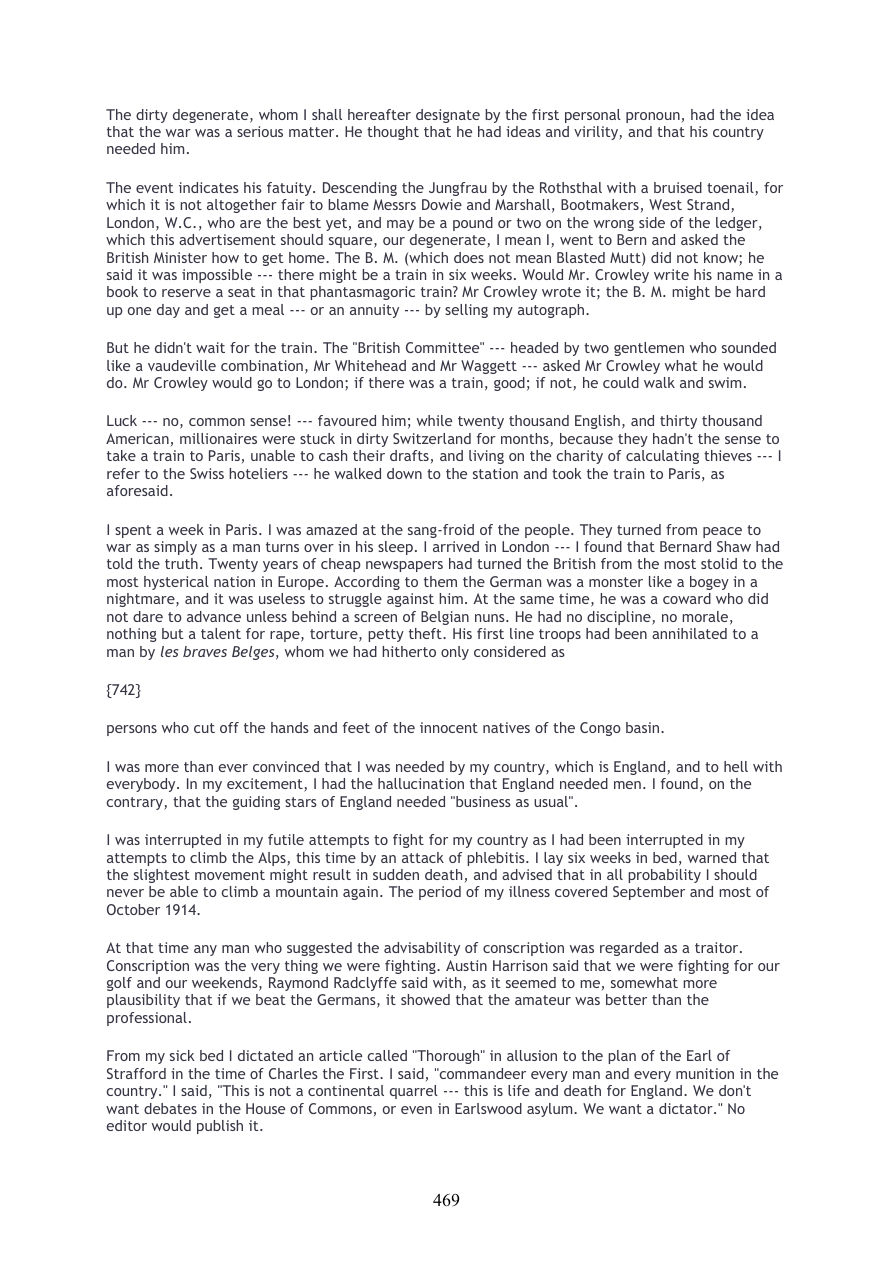
Highlights use the original PDF text layer. OCR-only matches may not be visible on the scan.
Transcription
Download text ↓raw extractionoriginal embedded textReview: unreviewed
469
The dirty degenerate, whom I shall hereafter designate by the first personal pronoun, had the idea
that the war was a serious matter. He thought that he had ideas and virility, and that his country
needed him.
The event indicates his fatuity. Descending the Jungfrau by the Rothsthal with a bruised toenail, for
which it is not altogether fair to blame Messrs Dowie and Marshall, Bootmakers, West Strand,
London, W.C., who are the best yet, and may be a pound or two on the wrong side of the ledger,
which this advertisement should square, our degenerate, I mean I, went to Bern and asked the
British Minister how to get home. The B. M. (which does not mean Blasted Mutt) did not know; he
said it was impossible --- there might be a train in six weeks. Would Mr. Crowley write his name in a
book to reserve a seat in that phantasmagoric train? Mr Crowley wrote it; the B. M. might be hard
up one day and get a meal --- or an annuity --- by selling my autograph.
But he didn't wait for the train. The "British Committee" --- headed by two gentlemen who sounded
like a vaudeville combination, Mr Whitehead and Mr Waggett --- asked Mr Crowley what he would
do. Mr Crowley would go to London; if there was a train, good; if not, he could walk and swim.
Luck --- no, common sense! --- favoured him; while twenty thousand English, and thirty thousand
American, millionaires were stuck in dirty Switzerland for months, because they hadn't the sense to
take a train to Paris, unable to cash their drafts, and living on the charity of calculating thieves --- I
refer to the Swiss hoteliers --- he walked down to the station and took the train to Paris, as
aforesaid.
I spent a week in Paris. I was amazed at the sang-froid of the people. They turned from peace to
war as simply as a man turns over in his sleep. I arrived in London --- I found that Bernard Shaw had
told the truth. Twenty years of cheap newspapers had turned the British from the most stolid to the
most hysterical nation in Europe. According to them the German was a monster like a bogey in a
nightmare, and it was useless to struggle against him. At the same time, he was a coward who did
not dare to advance unless behind a screen of Belgian nuns. He had no discipline, no morale,
nothing but a talent for rape, torture, petty theft. His first line troops had been annihilated to a
man by les braves Belges, whom we had hitherto only considered as
{742}
persons who cut off the hands and feet of the innocent natives of the Congo basin.
I was more than ever convinced that I was needed by my country, which is England, and to hell with
everybody. In my excitement, I had the hallucination that England needed men. I found, on the
contrary, that the guiding stars of England needed "business as usual".
I was interrupted in my futile attempts to fight for my country as I had been interrupted in my
attempts to climb the Alps, this time by an attack of phlebitis. I lay six weeks in bed, warned that
the slightest movement might result in sudden death, and advised that in all probability I should
never be able to climb a mountain again. The period of my illness covered September and most of
October 1914.
At that time any man who suggested the advisability of conscription was regarded as a traitor.
Conscription was the very thing we were fighting. Austin Harrison said that we were fighting for our
golf and our weekends, Raymond Radclyffe said with, as it seemed to me, somewhat more
plausibility that if we beat the Germans, it showed that the amateur was better than the
professional.
From my sick bed I dictated an article called "Thorough" in allusion to the plan of the Earl of
Strafford in the time of Charles the First. I said, "commandeer every man and every munition in the
country." I said, "This is not a continental quarrel --- this is life and death for England. We don't
want debates in the House of Commons, or even in Earlswood asylum. We want a dictator." No
editor would publish it.
Page provenance & review flags
Stable page ID: 5ef44b98d8f9c4af5f6f86e1:p00469
Line breaks are preserved. Reading order and OCR accuracy may need review.
Printed page label has not been verified.
- No automated review flags. This does not establish transcription accuracy.