1930 · CLOSE READING
Magick in Theory and Practice (Section 4)
Magick in Theory and Practice (Section 4) (1930), PDF p. 114
Original page
Enlarge ↗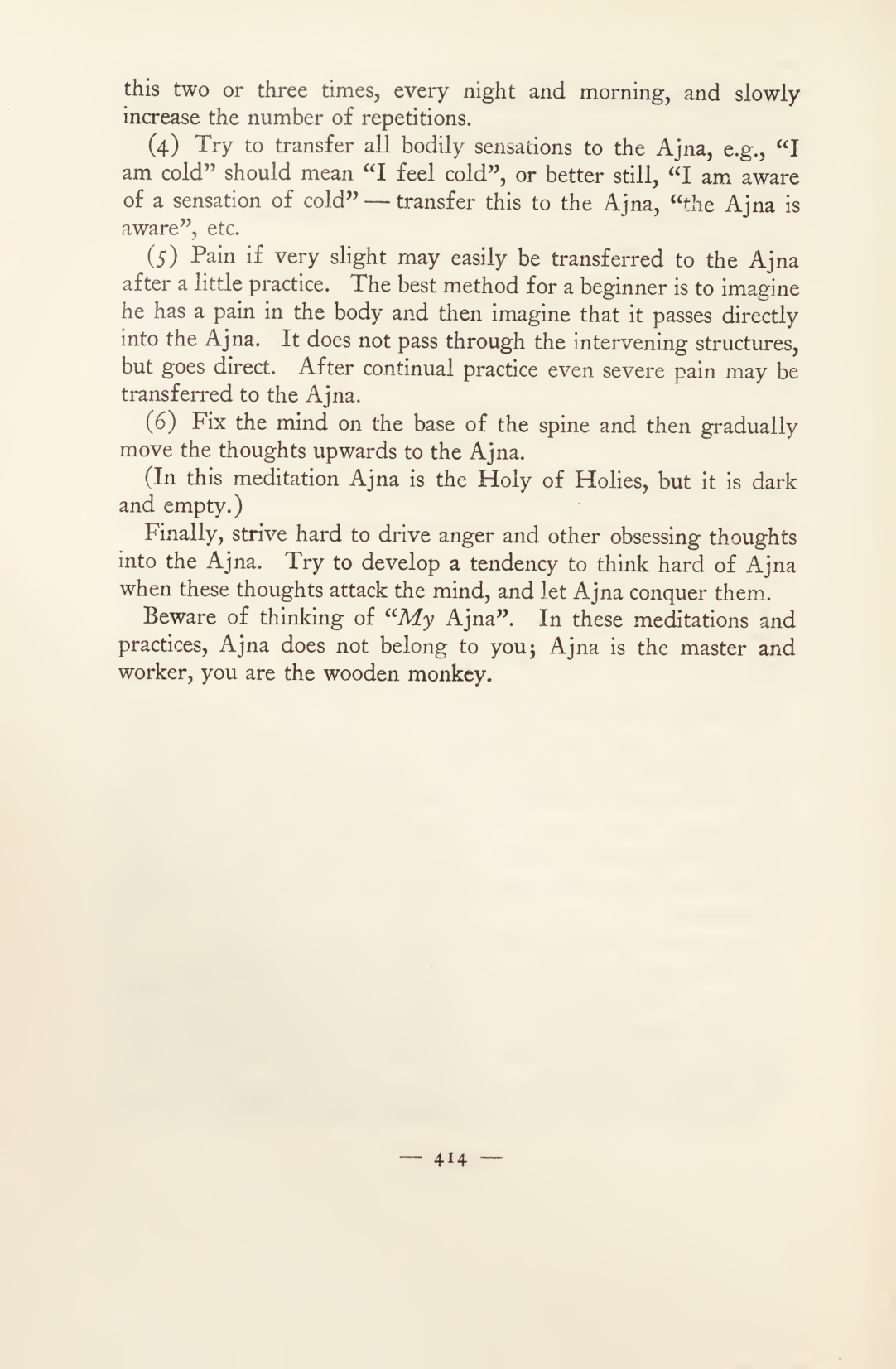
Highlights use the original PDF text layer. OCR-only matches may not be visible on the scan.
Transcription
Download text ↓raw extractionoriginal embedded textReview: unreviewed
this two or three times, every night and morning, and slowly
increase the number of répétitions.
(4) Try to transfer ail bodily sensations to the Ajna, e.g., “I
am cold” should mean “I feel cold”, or better still, “I am aware
of a sensation of cold” — transfer this to the Ajna, “the Ajna is
aware”, etc.
(5) Pain if very slight may easily be transferred to the Ajna
after a little practice. The best method for a beginner is to imagine
he has a pain in the body and then imagine that it passes directly
into the Ajna. It does not pass through the intervening structures,
but goes direct. After continuai practice even severe pain may be
transferred to the Ajna.
(6) Fix the mind on the base of the spine and then gradually
move the thoughts upwards to the Ajna.
(In this méditation Ajna is the Holy of Holies, but it is dark
and empty.)
Finally, strive hard to drive anger and other obsessing thoughts
into the Ajna. Try to develop a tendency to think hard of Ajna
when these thoughts attack the mind, and let Ajna conquer them.
Beware of thinking of aMy Ajna”. In these méditations and
practices, Ajna does not belong to y ou; Ajna is the master and
worker, you are the wooden monkey.
414 —
Page provenance & review flags
Stable page ID: 7753951376af2a884c0b63fa:p00114
Line breaks are preserved. Reading order and OCR accuracy may need review.
Printed page label has not been verified.
- No automated review flags. This does not establish transcription accuracy.