1944 · CLOSE READING
The Book of Thoth
The Book of Thoth (1944), PDF p. 61
Original page
Enlarge ↗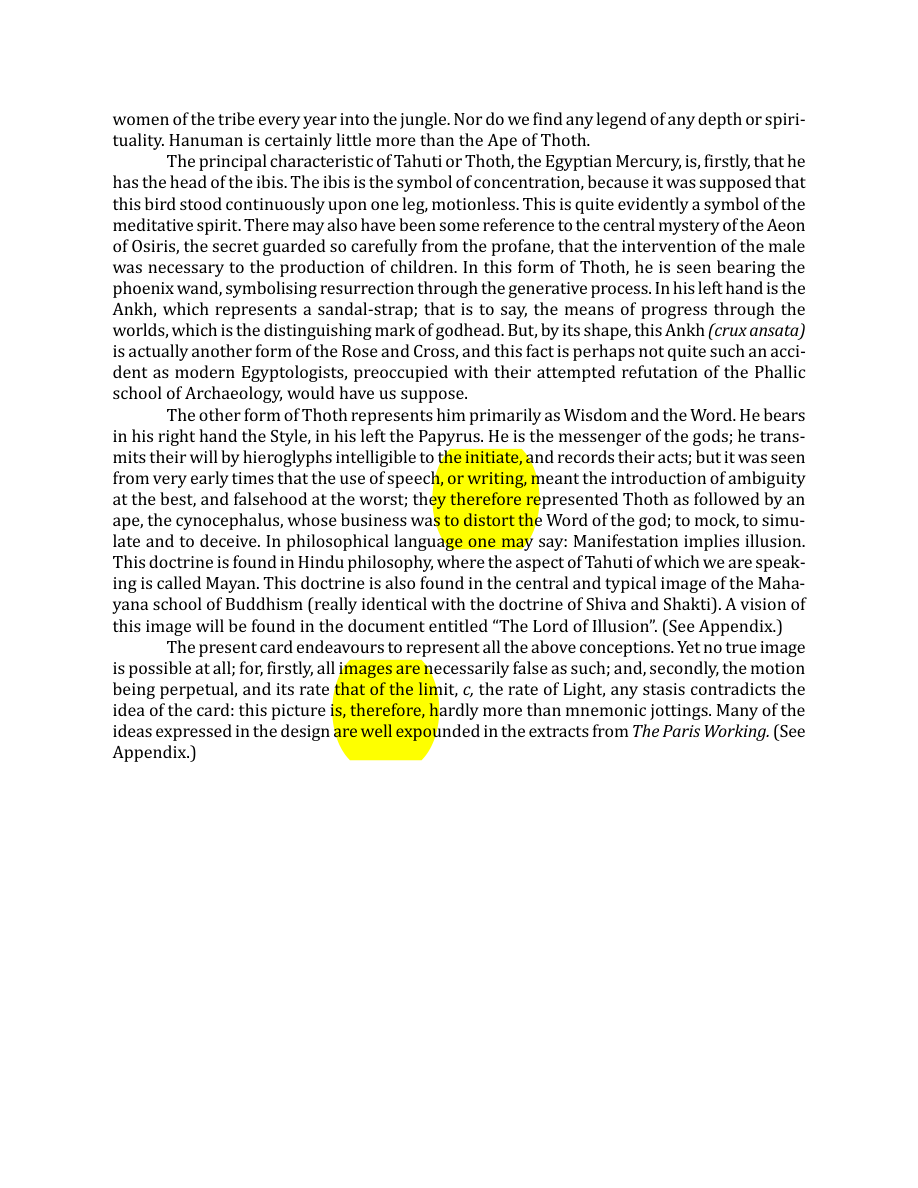
Highlights use the original PDF text layer. OCR-only matches may not be visible on the scan.
Transcription
Download text ↓raw extractionoriginal embedded textReview: unreviewed
women of the tribe every year into the jungle. Nor do we find any legend of any depth or spiri‐
tuality. Hanuman is certainly little more than the Ape of Thoth.
The principal characteristic of Tahuti or Thoth, the Egyptian Mercury, is, firstly, that he
has the head of the ibis. The ibis is the symbol of concentration, because it was supposed that
this bird stood continuously upon one leg, motionless. This is quite evidently a symbol of the
meditative spirit. There may also have been some reference to the central mystery of the Aeon
of Osiris, the secret guarded so carefully from the profane, that the intervention of the male
was necessary to the production of children. In this form of Thoth, he is seen bearing the
phoenix wand, symbolising resurrection through the generative process. In his left hand is the
Ankh, which represents a sandal‐strap; that is to say, the means of progress through the
worlds, which is the distinguishing mark of godhead. But, by its shape, this Ankh (crux ansata)
is actually another form of the Rose and Cross, and this fact is perhaps not quite such an acci‐
dent as modern Egyptologists, preoccupied with their attempted refutation of the Phallic
school of Archaeology, would have us suppose.
The other form of Thoth represents him primarily as Wisdom and the Word. He bears
in his right hand the Style, in his left the Papyrus. He is the messenger of the gods; he trans‐
mits their will by hieroglyphs intelligible to the initiate, and records their acts; but it was seen
from very early times that the use of speech, or writing, meant the introduction of ambiguity
at the best, and falsehood at the worst; they therefore represented Thoth as followed by an
ape, the cynocephalus, whose business was to distort the Word of the god; to mock, to simu‐
late and to deceive. In philosophical language one may say: Manifestation implies illusion.
This doctrine is found in Hindu philosophy, where the aspect of Tahuti of which we are speak‐
ing is called Mayan. This doctrine is also found in the central and typical image of the Maha‐
yana school of Buddhism (really identical with the doctrine of Shiva and Shakti). A vision of
this image will be found in the document entitled “The Lord of Illusion”. (See Appendix.)
The present card endeavours to represent all the above conceptions. Yet no true image
is possible at all; for, firstly, all images are necessarily false as such; and, secondly, the motion
being perpetual, and its rate that of the limit, c, the rate of Light, any stasis contradicts the
idea of the card: this picture is, therefore, hardly more than mnemonic jottings. Many of the
ideas expressed in the design are well expounded in the extracts from The Paris Working. (See
Appendix.)
Page provenance & review flags
Stable page ID: c2293fa5b8d18e0cf1f666dc:p00061
Line breaks are preserved. Reading order and OCR accuracy may need review.
Printed page label has not been verified.
- No automated review flags. This does not establish transcription accuracy.